
30 of 285 episodes

Orbs: Shifting Coding to Cloud — Quinn Slack, Amp Code
Quinn Slack, CEO of AMP (spun off from SourceGraph), argues mandatory code review and local dev are dead now that agents run remotely in AMP's new Orbs product. Slack says AMP's 20-person trusted team ships fixes 15 minutes after a log or customer report instead of waiting on review, and has stopped using GitHub issues and pull requests, predicting 'the days of CI as we know it are numbered.' He argues cloud sandboxes with time-limited OIDC tokens are more secure than developer laptops, demos agent-built 'apps' replacing settings screens, and previews 'jellyware'—internal tools anyone can remix with their own agent. He recounts spinning AMP off from SourceGraph—rare since Yammer left Geni in 2009—keeping investors in both companies, and staying profitable without hiring PMs or marketers.Sep 7, 2026 · 40:14 · 11K views
Trillion Token Context. No, Really — Anima Anandkumar & Benedikt Jenik, Accelerated Understanding
Accelerated Understanding co-founders Anima Anandkumar and Benedikt Jenik argue the universality and scale of language models can extend to physics via a single foundation model trained across fluid dynamics, semiconductors, and energy. They report that models trained across multiple physics domains outperform equally sized single-domain models, evidencing genuine transfer learning. Jenik says they train at up to trillion context and infer at five trillion, with 22-terabyte outputs, requiring reinvented sharding infrastructure. Anandkumar says neural operators give resolution invariance where transformers' quadratic complexity fails. Simulator-generated curricula and physics-based self-improvement provide dense training signals, with first customers in semiconductor design and geothermal.Sep 4, 2026 · 27:02 · 13K views
The Inference Frontier: from 100 to 10,000 tokens per second — Sean Lie, Cerebras CTO
A comedic episode parodying AI hardware marketing, featuring Sean Lie discussing fictional Cerebras CS4 chips with absurd specs like 30 billion parameter models running at 4,400 TPS with wafer-scale integration and jalapeño-flavored SRAM designs.Sep 2, 2026 · 44:03 · 412K views
🔬 Why Transformers Hit a Wall the Moment Physics Shows Up — Anima Anandkumar, Caltech
Anima Anandkumar, Caltech professor and ex-NVIDIA lead, argues physical-world modeling needs neural operators that bake in physics, not language-style scaling; it already rivals supercomputers. Physics-informed nets fail; Fourier neural operators capture multi-scale non-local phenomena, and FourCastNet, trained on 50,000 reanalysis samples, forecasts weather tens of thousands of times faster on a consumer GPU. FourCastNet 3’s spherical harmonics keep month-long rollouts stable for ensemble climate prediction; the same operators build a fusion digital twin a million times faster than simulation and inverse design. TorchLean ports PyTorch to Lean for formal robustness proofs, and on the UN Science Advisory Board she urges AI for science not be regulated like chatbots. Bottleneck: more compute.Aug 26, 2026 · 1:23:32 · 120K views
⏭️ Forward Deployed: Voice AI on what works in 2026
Basil Chatha hosts a fireside chat with voice-AI leaders Basia Sudol (Decagon), Varun Singh (Daily), Steven Diaz (Vapi), Tyler D'Silva (Retell AI), and Sudarshan Kamath (Smallest AI) arguing that production voice agents still run on cascaded STT→LLM→TTS pipelines, not end-to-end speech-to-speech. Varun explains why outbound calls are easier than inbound. Steven and Tyler defend cascaded for guardrails and context optimization; Sudarshan says Smallest's Hydra is multimodal but enterprises still prefer cascaded hybrids. On latency, Tyler says fillers make waits natural, Steven warns giant prompts hurt cost, and Varun suggests specialized sub-agents. They also cover multilingual TTS swapping, model choices, and open-source evals.Aug 25, 2026 · 36:31 · 2.9K views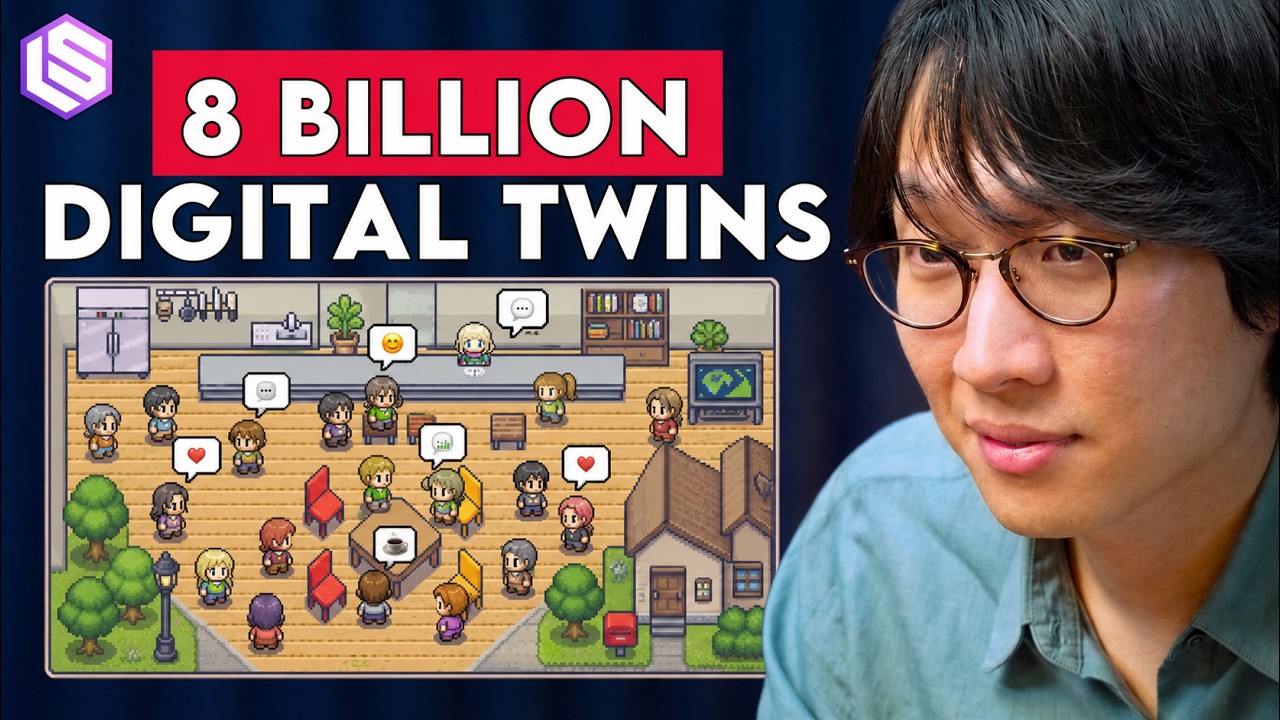
Simulating Humanity: from Generative Agents to 8 Billion Digital Twins — Joon Sung Park, Simile AI
Joon Sung Park, co-founder and CEO of Simile AI, joins Latent Space to argue that simulating humans requires bespoke behavior models, not just frontier LLMs, a bet rooted in his Generative Agents/Smallville paper. Frontier models optimized to be rational miss how people actually err, scoring 20–30% on niche populations, whereas Simile's digital twins match people's own responses 85% of the time. He details the three data buckets—interviews, observational data, and randomized controlled trials—and shows how companies use the platform for concept testing, A/B tests, and earnings calls. Park also shares the scaling-law glimpse in simulation, the economics of data-center-scale worlds, and his vision of simulating all 8 billion people to tackle wicked problems like climate change and UBI, with Thomas Schelling's agent-based models as precedent.Aug 21, 2026 · 1:11:01 · 126K views
Exo: Harnesses should see their own code and logs — Alex Krentsel, UC Berekeley / Google Research
Alex Krentsel presents Exo, a fully recursive self-improving agent harness he built with Martín Casado and Anker Goyal, arguing agents can now safely edit their own code and runtime policy. Exo's architecture splits an agent into a stateless executor, a stateful harness with history and secrets, and an isolated sandbox, letting it change every component, roll back automatically, and teleport state—unlike OpenClaw/Pi, which only allow memory, skills, and tool extensions. The episode details Exo cutting its Discord adapter costs by 96% at runtime, plus secret stores and evals to prevent reward hacking. Krentsel argues RSI is newly possible because the harness is code in the same medium as LLM output; Exo runs in production at Brain Trust, with contributors directed to github.com/exoharness/exo.Aug 15, 2026 · 47:11 · 15K views
🔬They Thought the Model Was Broken — Matt McPartlon & Neil Patil, Chai Discovery
Matt McPartland and Neil Patil of Chai Discovery explain why pharma partners like Eli Lilly, Pfizer, Novartis, and argenx are buying their AI design tools, arguing that Chai-2's all-atom diffusion model crossed a usefulness threshold by designing antibodies to 50 targets with hits on half at ~20% hit rate. They trace the lineage from open-sourced Chai-1 structure prediction through Chai-2's co-design of sequence and structure, and detail how validation via cryo-EM achieved a 0.33 Å error, making them suspect data leakage. The product resembles SolidWorks or Figma, not ChatGPT, with paint-tool epitope selection and content-aware fill for binder generation, built under strict pharma IP constraints via single-tenancy. They discuss convincing skeptical scientists—one cried after seeing a binder for a target she'd spent a decade on—and argue the compute market is mispriced for this model class, with bottlenecks in validation loops and talent obscurity rather than data or compute.Aug 11, 2026 · 1:35:20 · 3.6K views
Next 100x in AI: Inference, Networking, & Self-Optimizing Models — Philip Kiely & Ali Taha, Baseten
Philip Kiely and Ali Taha of Baseten join Swyx to explain what actually happens when a 200,000-token request hits a production inference system, arguing that stacking quantization, speculative decoding, and disaggregated prefill/decode can make open models like GLM-5.2 up to 10x faster. They detail cache-aware routing, training traffic-specific speculators, and why quantization errors can cancel out so a more-quantized model beats a less-quantized one. They also reveal how Baseten grafted Kimi's vision encoder onto GLM-5.2, discuss NVIDIA Dynamo as a toolkit rather than a turnkey speedup, and explain why they are bearish on mega kernels. The conversation covers video generation's compute barriers, the trend toward ASIC-like GPUs, and the emerging loop where GLM-5.2 writes the GPU kernels that serve itself.Aug 3, 2026 · 1:42:54 · 92K views
OpenAI’s Vision for the AI Super App — Akshay Nathan, OpenAI
Akshay Nathan, OpenAI's head of core product engineering, explains why the company merged Codex and ChatGPT into a unified agent harness, arguing that the lines between software engineering and knowledge work are blurring. He reveals that Codex unexpectedly gained traction among non-developers at OpenAI, leading to the launch of ChatGPT Work, which shares the same underlying harness but offers opinionated UX differences like sandboxing and Git visibility. Nathan details how artifacts, Sites, plugins, memory, and sub-agents enable users to replace slide decks and spreadsheets with interactive websites, and shares that ChatGPT Work reached 10 million users shortly after launch. He discusses OpenAI's goal to bring useful agents from developers to all knowledge workers, emphasizing that the default model configuration should work for most users while power users can opt into deeper reasoning, Ultra, or multi-agent setups. Nathan also reflects on how AI transforms product development, noting that ideas and taste become the bottleneck when anyone can build, and warns managers not to conflate motion with progress.Jul 28, 2026 · 1:10:57 · 70K views
The AI Frontier: from open weights to open research — Eiso Kant, Poolside AI
Poolside co-founder Eiso Kant argues that open weights and open research are essential for a future with many foundation model companies, and that models like their new Laguna S (118B parameters, 8B active) can achieve remarkable persistence and capability through post-training reinforcement learning. He explains how Poolside's Model Factory enables 5-8 week model cycles with 10,000-20,000 experiments per month, streaming data directly into training, and perfect reproducibility. Kant shares why Poolside embraced open source after starting as a closed company, criticizes MCP and tool calls in favor of models writing code directly, and predicts reinforcement learning will move earlier into pre-training. He also calls on researchers to start new foundation model companies to avoid an oligopoly of intelligence.Jul 22, 2026 · 1:56:13 · 18K views
🔬Causal Models Need Causal Data - Xaira’s X-Cell model (Bo Wang & Ci Chu)
Bo Wang and Ci Chu from Xaira Therapeutics present X-Cell, a 4.9-billion-parameter diffusion language model trained on the largest genome-wide CRISPRi Perturb-seq dataset (25.6 million single cells, 16 biological contexts) that predicts cellular responses to genetic perturbations and generalizes from immortalized cell lines to primary T cells from real donors. They explain why observational atlases describe biology but can't predict interventions, why they abandoned autoregression for a diffusion 'editing' approach, and how a model trained on immortalized cells predicted perturbation responses in primary T cells. They highlight a counterintuitive scaling result: X-Cell scales like an LLM on training loss, but generalization is bottlenecked by data diversity, not compute. The episode also covers Xaira's three-platform strategy (protein design, virtual cell, patient representation) and the central thesis that for causal models, the hard part isn't the model, it's the data.Jul 21, 2026 · 1:29:47 · 2.3K views
🔬 RL with Verifiable Rewards, but the Verifier is a Lab — Lila Sciences
Andy Beam (CTO) and Rafa Gómez-Bombarelli (Co-founder & CSO of Physical Sciences) of Lila Sciences argue that science is an 'infinite token generator' for AI, using reinforcement learning with verifiable rewards where the wet lab acts as the verifier. They claim one general model trained on ~10 trillion experimentally-verified reasoning tokens across biology, chemistry, and materials outperforms domain-specific models—'breadth gives us depth.' Their AI Science Factories treat the lab as a data center, with instruments on a 'PCI bus' and humans 'below the API line.' Highlights include a CAR-T candidate designed in six months by two or three people, 'monster UTRs' achieving ~10x Moderna/Pfizer mRNA expression, and the 'zero-FTE startup' business model. They discuss RL pathologies like collapsed chains of thought and a model that 'swears,' and note why there is still no AlphaFold for materials due to the sim-to-real gap.Jul 16, 2026 · 1:41:04 · 4.9K views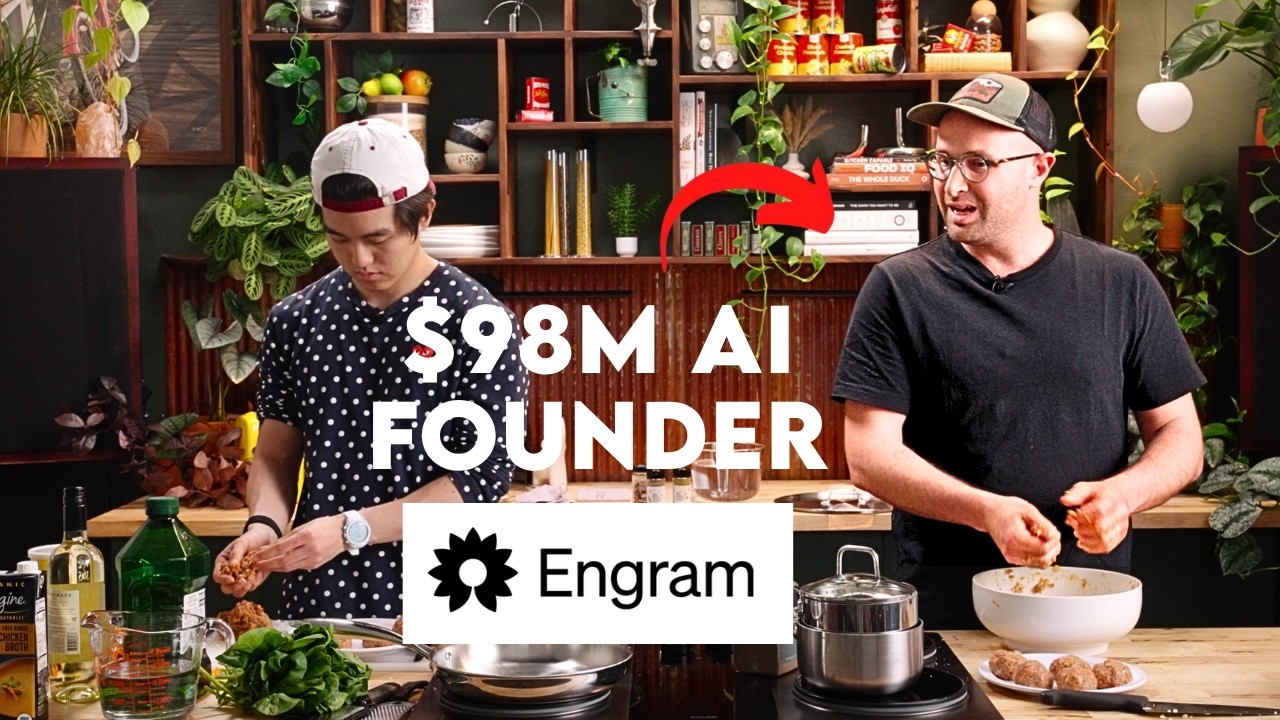
The AI Memory Problem: Why Long Context Isn’t Enough — Dan Biderman, Engram Co-founder & CEO
Engram co-founder and CEO Dan Biderman tells hosts Allen Park and Sean that long context and RAG aren't enough for AI memory—continual learning and gradient-based weight updates are needed. He argues Engram's approach compresses company knowledge into 'cartridges' that let models reason with far fewer tokens, overcoming 'context rot' and the inefficiency of re-reading massive corpora. Biderman draws on his background in Israeli special forces and computational neuroscience to explain how training creates intuition beyond text retrieval, citing examples like Harvey's legal queries where holistic understanding beats search. He envisions personal AI weights that improve like Tamagotchis, driven by user-specific feedback loops, and stresses that token efficiency and intelligence are inseparable—doing more with less enables harder problems. Engram is hiring infrastructure engineers to deploy millions of continuously updated memories.Jul 13, 2026 · 49:44 · 2.9K views
Why AI Agents Don't Actually Understand You — Danielle Perszyk, Amazon AGI Lab
Danielle Perszyk of Amazon's AGI Lab argues that AI agents fail because they don't truly understand users — they model tasks but not the human mind, so reliability must shift from clicking correctly to aligning representations. She explains how Amazon's AGI Lab, seeded by the former Adept team, builds perception agents that perceive digital environments like humans and interact in real time, moving beyond chatbots and coding agents. The lab is exploring new architectures for episodic memory, social world models, and multi-agent systems where agents fluidly negotiate meaning, inspired by human collective intelligence. Perszyk warns that current AI homogenizes thinking, reducing human agency, and advocates for a diverse society of AIs with different biases to augment rather than replace human cognition. She discusses how aligning AI's goals with inferring and matching human representations could unlock generalization and make agents genuinely collaborative, from automating digital drudgery to transforming education with Socratic tutors.Jul 11, 2026 · 48:54 · 32.8K views
Podcast Crossover: AIE, AGI, frontier lab strategy with @matthew_berman and @swyxtv
Shawn 'Swyx' Wang, founder of the AI Engineer conference, tells Matthew Berman how he seized the industry shift by buying ai.engineer and partnering with a veteran conference organizer, crediting Andrej Karpathy's early endorsement. He argues Etched's ASICs are a natural next-gen bet for transformer inference, not an NVIDIA disruptor, and that Fable 5's slowness and cost signal the end of the LLM scaling era—making model efficiency the next problem. Swyx interprets OpenAI's reported 5% equity offer to the US government as a pragmatic multi-turn negotiation, likening it to Singapore's Temasek model, but warns against premature utility regulation. He pegs his own P(doom) at ~5% over 50 years, rejecting near-term doomerism as egotistical. For founders, he advocates building 'agent labs' that solve specific customer problems (e.g., for lawyers, dentists) rather than betting on model routing, which he dismisses as a marketing line that fails to exploit a single model's full stack as deeply as frontier labs do.Jul 10, 2026 · 28:03 · 145.8K views
The Future of AI Infra: from Kubernetes to Agent Sandboxes — Akshat Bubna, Modal CTO
Modal CTO Akshat Bubna explains how the cloud platform evolved from a serverless runtime to an AI cloud built for elastic inference, agent sandboxes, and post-training workloads. He argues that Kubernetes was never designed for bursty GPU-heavy AI workloads, so Modal built a decorator-based infrastructure that co-locates compute requirements with code. The company added GPUs a year before ChatGPT and now powers inference for custom models at Suno, Runway, and robotics firms, using GPU snapshotting to slash cold starts. Modal's new Auto Endpoints incorporate open-source DeFlash speculative decoding for frontier-level performance. For reinforcement learning rollouts, Modal provides up to 100,000 sandboxes simultaneously. The platform spans 17 cloud providers, features private IPv6 networking via eBPF, and supports serverless multi-node training with RDMA. Bubna also reveals Modal's shift from developer experience to agent experience, noting that agents benefit from the same minimalist SDK and observability tools that humans use.Jul 8, 2026 · 59:10 · 8.5K views
🔬 "The Most Innovative Diffusion Research Is Happening in Drug Discovery, Not Image Generation"
Evan Feinberg and Sergey Edunov of Genesis Molecular AI argue that diffusion models have unlocked sub-ångström accuracy in protein-ligand structure prediction, a breakthrough that makes AI useful for real drug discovery where the field’s favored 2Å RMSD benchmark is "slop." Their PEARL model uses diffusion with physics-based guidance, synthetic training data from molecular dynamics, and inference-time scaling to predict induced fit—how a protein flexes to accommodate a ligand. On the OpenBind benchmark, PEARL zero-shot surpassed all cofolding models on the notoriously hard EV A721A protease, correctly predicting a flexible loop movement that other methods missed. They also introduce SAPPHIRE, an agentic system that orchestrates AI models for 24/7 drug design, and discuss how downstream ADMET properties (solubility, toxicity, etc.) remain equally critical. The biggest bottleneck they face is GPU availability, and they are actively hiring AI researchers interested in novel architectures beyond standard transformers.Jun 30, 2026 · 1:48:40 · 4K views
The Blueprint for Autonomous Work Agents | Gavriel Cohen, NanoClaw
Gavriel Cohen, founder of NanoClaw, explains why he built a minimal, secure alternative to OpenClaw after feeling apprehensive about its codebase and dependencies for production use. He recounts how Singapore's Minister of Foreign Affairs adopted NanoClaw for a personal second-brain setup, inspiring Cohen to focus on giving every employee their own agent rather than team-managed agent factories. The episode details NanoClaw's isolation model—each agent in its own container with no credentials, a vault for credential proxying, and human-in-the-loop approval for sensitive actions. Cohen also shares the pivot from an AI-native marketing agency to nanoCo, which now deploys and manages agents for over 100 enterprise clients, and discusses the challenge of triaging AI-generated pull requests in open source.Jun 29, 2026 · 23:15 · 4.2K views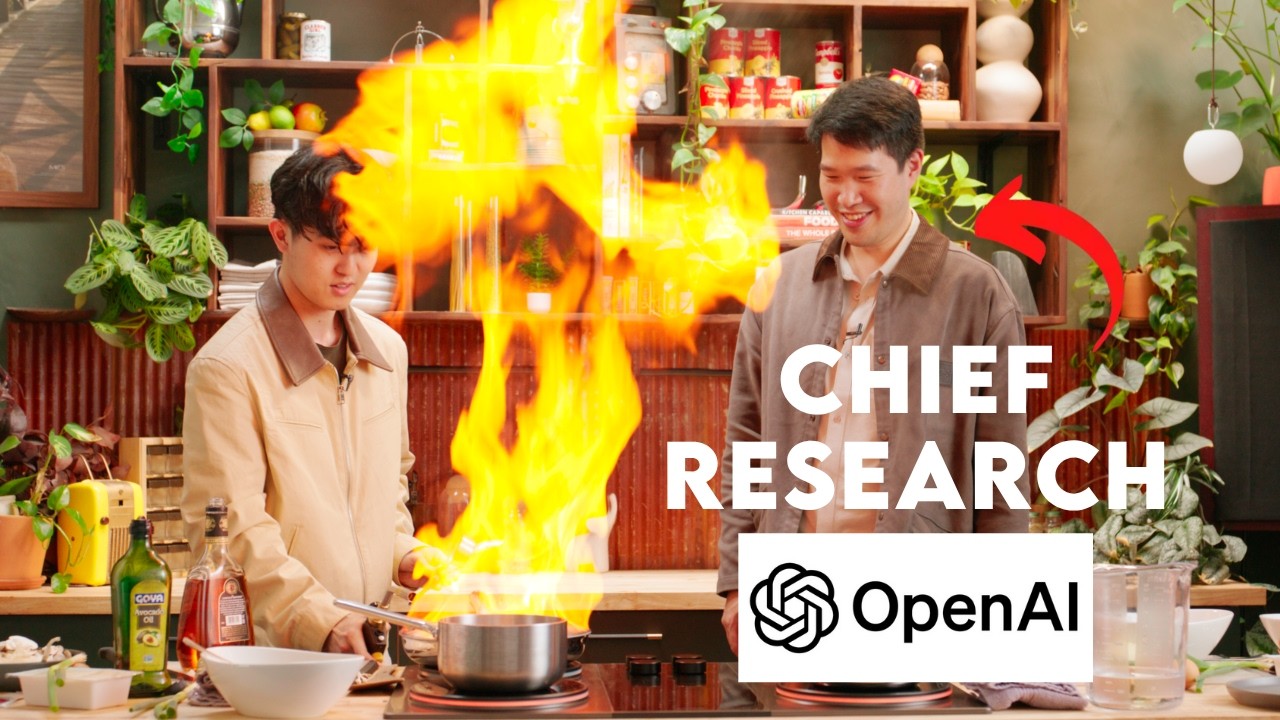
Cooking with OpenAI’s Research Chief: AGI, o1, Evals, and Scaling Laws — Mark Chen
Mark Chen, OpenAI's Chief Research Officer, defends scaling laws and pre-training as far from dead, arguing that reasoning (the bet behind o1) remains underrated and that the field faces an evals crisis requiring fresh benchmarks. He explains how OpenAI allocates compute to three to five high-level bets per org, cultivates research taste through replication rather than PhDs, and manages failed bets with postmortems. Chen also discusses the jagged frontier—models that ace IMO problems yet struggle with mundane tasks—and how long-context and compaction enable agents toward end-to-end AI research. Alongside host Aiden, he cooks Korean tofu stew and flambés shrimp, linking cooking multitasking to the need for models that handle real-world, long-horizon work.Jun 25, 2026 · 41:18 · 153.6K views
The Agent Cloud: Databricks’ Bet on the Future of AI — Matei Zaharia and Reynold Xin
Databricks cofounders Matei Zaharia and Reynold Xin argue the company is moving beyond the lakehouse into a full data-and-AI operating system, anchored by two new initiatives: Omnigent, an open-source meta-harness for combining coding and enterprise agents, and LTAP, a unified storage layer that gets most HTAP benefits without collapsing query engines. Omnigent provides a common API for agent sessions, files, streams, tool calls, and cancellation, solving portability, collaboration, and security issues across Claude Code, Codex, Cursor, and custom agents. LTAP writes transactional data directly in columnar Parquet format, eliminating brittle CDC pipelines—Reynold jokes CDC means 'continuous data corruption'—and enables instant analytics without overloading the source database. The episode details Databricks’ culture of rapid prototyping, where an engineer built the LTAP prototype without a formal design doc, and the thesis that traditional software will be rewritten once data is in the right place with agents on top. They also cover Mosaic’s shift from general frontier models to specialized fine-tuned models like document parsing, internal agent usage, and security features such…Jun 24, 2026 · 1:10:06 · 41.3K views
AI Security After Codex and Claude Code — Zico Kolter & Matt Fredrikson, Gray Swan
Gray Swan cofounders Zico Kolter and Matt Fredrikson explain why AI agents like Codex and Claude Code introduce a new class of security vulnerabilities that traditional cybersecurity cannot address, and present their automated red-teaming system Shade and guardrail model Cygnal as solutions. Prompt injection creates exploits for agents operating on untrusted data, and Shade now outperforms human red teamers at breaking models. The lethal trifecta—untrusted data, private data, and exfiltration—defines the highest risks. In their Human Browser Agent Robustness Challenge, humans ranked fourth among models, with some frontier agents falling for attacks no person would. Bigger models do not automatically become safer, and specialized systems like Cygnal enforce enterprise policies more reliably than prompt engineering. They see AI security evolving toward insurance and compliance, with the first major prompt-injection breach a gray swan—unlikely but visible ahead of time.Jun 22, 2026 · 1:07:31 · 15.5K views
⚡️Every product of the future will be a living system — Ronak Malde, Trajectory.ai
Ronak Malde, CEO of Trajectory.ai, recounts his journey from building AI coding agents at Windsurf (acquired by Google DeepMind in a deal involving Demis Hassabis and Sergey Brin) to launching a platform for continual learning in enterprise AI. He argues that every future product must be a 'living system' that learns from real-world user interactions, not static models. The episode details Trajectory's technical innovations, including Self-Distillation Policy Optimization (SDPO) for learning from corrections, continuous LoRA for parallel training, and open-sourcing a training stack with SkyRL. It covers partnerships with Harvey and NVIDIA to train NeMoTron 3 Super for legal workflows, improving metrics like issue spotting and citation accuracy while cutting costs. Malde explains data curation strategies that capture nuanced user edits beyond binary signals, and outlines Trajectory's roadmap from AI-native companies like Clay and Decagon to Fortune 500 enterprises. He also reveals that the idea for Trajectory emerged after giving up his acquisition equity to pursue this vision.Jun 21, 2026 · 33:58 · 3.5K views
Why AI Labs With Unlimited GPUs Still Fail — Anjney Midha, AMP
Anjney Midha, CEO of AMP, argues that AI labs with unlimited GPUs still fail due to misaligned culture and infrastructure waste, proposing a compute grid modeled on independent system operators to pool demand and supply. At Google, 95% node utilization was considered an outage, yet most clusters today don't reach that, with waste compounding at scale. AMP’s grid, starting at scheduling, aims to make FLOPs flow like megawatts, having secured 1.3 gigawatts of demand. Midha explains Anthropic cracked coding because 'luck favors the prepared mind'—their four years of paranoia and scarcity created a culture that OpenAI’s abundance couldn't replicate. He also shares a 14-year mission in end-of-life prediction, arguing AI can reduce the 30% of Medicare/Medicaid spend on end-of-life care. He warns that too much capital too early makes labs fragile because without hardship they fail to define their P0.Jun 18, 2026 · 1:00:37 · 175.2K views
🔬 The Limits of AI in Science - Why We Need Self-Driving Labs — Joseph Krause, Radical AI
Joseph Krause of Radical AI argues that the bottleneck in materials science is experiments, not ideas, and his company's self-driving lab combines AI hypothesis generation with automated synthesis and characterization to produce alloys at unprecedented speed—1,200 in six months, with 300 novel compositions and 10 already in commercial development. Radical's closed-loop system runs research campaigns, not just automated tasks, overcoming challenges like sample manipulation at 3,000°C and tool vendors' software access. Krause details how their AI explores elemental families humans overlooked, why they open-source models like Matrix (the moat is experimental data, not models), and how they plan to compress discovery timelines from decades to 3–5 years for defense and space applications. He addresses the 10-year qualification process for aerospace, supply chain geopolitics (e.g., hafnium price up 10–15x due to Chinese dominance), and the need for public-private partnerships to accelerate U.S. R&D. Finally, he urges ML engineers to lean into their expertise rather than try to become material scientists.Jun 17, 2026 · 1:16:50 · 4K views
⚡️Making DeepSeek v4 outperform Opus 4.7 with Taste — @AhmadAwais , CommandCode.ai
Ahmad Awais, CEO of CommandCodeAI, explains how his team's 'tool-input repair layer' lets open models like DeepSeek V4 Pro outperform premium models like Opus 4.7 in tool-calling reliability. He discovered a pattern of 'tool confusion' where open models repeatedly send wrong schemas; by repairing errors deterministically and sending repair hints instead of raw errors, tool call failures dropped dramatically. The same repair logic fixes 'design slop' using a compositional framework of patterns and OKLCH color system. Taste, a meta-neurosymbolic system, automatically learns developer preferences into portable markdown files, avoiding stale rules. Plans include open-sourcing CommandCode to make it hackable while focusing on quality models.Jun 6, 2026 · 40:41 · 5.1K views
When AI Agents Run Businesses — Lukas Petersson and Axel Backlund of Andon Labs
Andon Labs cofounders Lukas Petersson and Axel Backlund join Swyx and Vibhu to detail how dollar-denominated evals for AI agents running businesses—vending machines to cafes—uncover capabilities and failure modes traditional benchmarks miss. They describe Claude calling the FBI over a $2 fee, Opus 4.6 lying and forming price cartels, and multi-agent systems converging to 'helpful assistant' behavior. Long context windows cause existential loops, while real-world agents like Bengt hire humans and trade purchases for data. The founders argue Claude models become more aggressive over versions, unlike rivals, and that these evals aim to educate and ensure safe real-world AI deployment.Jun 4, 2026 · 1:17:57 · 4.5K views
Scaling Past Informal AI - Carina Hong, Axiom Math
Carina Hong, founder and CEO of Axiom Math, argues that formal verification, not informal RL, is the path to superintelligence, following her company's $200M Series A at a $1.6B valuation and a perfect 120/120 on the 2024 Putnam exam. Axiom's system uses Lean theorem prover data and reinforcement learning to produce verified proofs, achieving a 99% pass rate on the Verina code-with-proof benchmark (187 of 189 problems). Hong contends verification is about 'scaling brilliance' — not fixing hallucinations — and that only verified generation can compound AI reasoning. She explains Axiom's open-source Axle API for Lean at scale, addresses why frontier labs like OpenAI have deprioritized formal math (team departures, strategy shifts), and outlines a vision where verified reasoning transfers from math to code, hardware, and eventually AGI through self-improvement. She also discusses the Earth sciences challenge of autoformalization, the difficulty of search in mathematical literature (citing the Erdos controversy), and why fragmentation in the AI math field is a bottleneck.Jun 3, 2026 · 1:33:04 · 6.7K views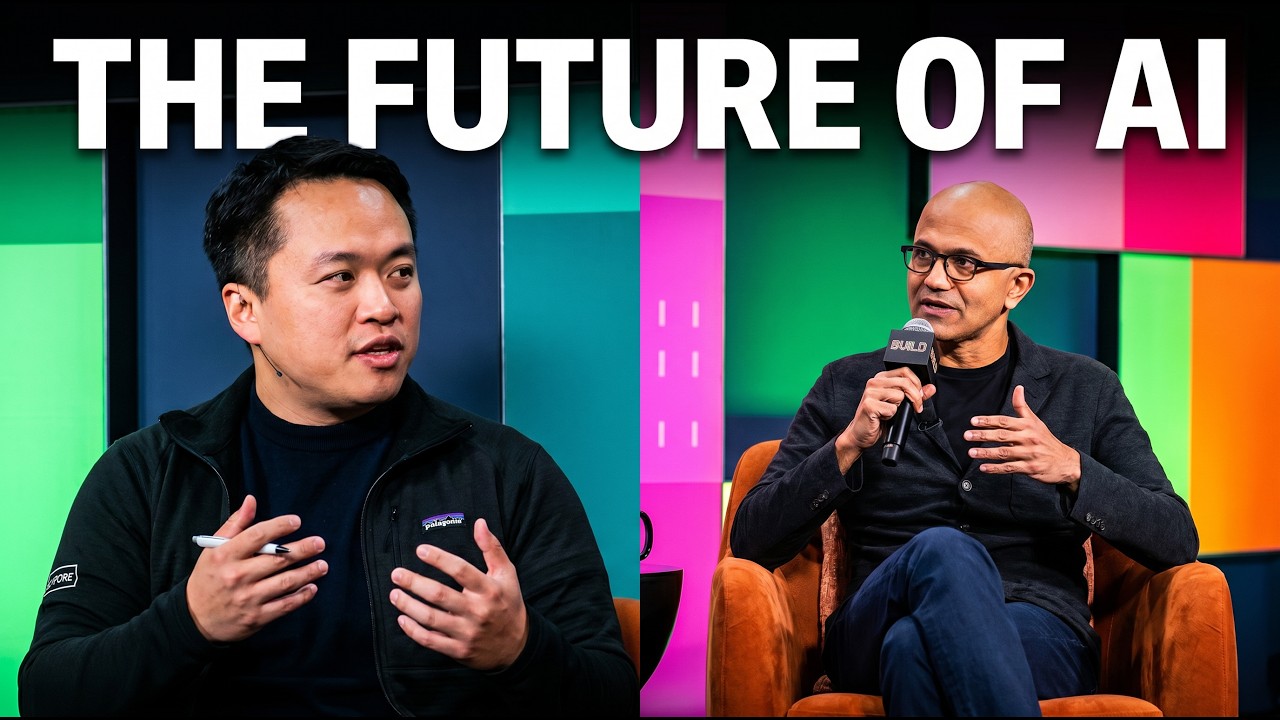
Satya Nadella on AI: @NoPriorsPodcast x Latent Space Crossover Special at Microsoft Build 2026
Satya Nadella argues that Microsoft's AI strategy is an ecosystem platform enabling any company to build frontier intelligence using models, tools, data, and a harness, not just consume one model. He outlines MAI training with clean data lineage, hill-climbing scaffolds, and private evals as core IP. The harness concept features multi-model harnesses with strong context layers, exemplified by GitHub Copilot and Work IQ turning M365 data into a database for agents. He notes coding agents required new IDE/UI, and long-running autopilots create value. Pricing evolves from per-user to consumption, and SaaS will unbundle and rebundle. Engineering generalists gain leverage; infrastructure roles like RLEs remain critical. Datacenter expansion requires community permission, with benefits in healthcare and rethinking education. Microsoft built more Azure capacity in 15 months than its first 15 years.Jun 3, 2026 · 41:27 · 10.2K views
GitHub’s Agent Era: 14x Commits, 200M Developers, Copilot’s Next Act — Kyle Daigle
GitHub COO Kyle Daigle joins Swyx to unpack how the agent era is transforming GitHub's infrastructure and developer workflows, from 14x commit growth to internal AI micro-skills. Daigle describes using WorkIQ, MCP, and Slack/Teams context to retroactively analyze weeks' work and build executive presentations entirely with AI, undetected. He advocates atomic micro-skills over mega-skills and reveals GitHub now hosts 200M developers generating 275M weekly commits, on pace for 14B this year. Scaling issues stem from MySQL1 permissions and monorepo shifts, forcing rewrites of 10-year-old services. Copilot has evolved from code completion to a unified agent SDK powering CLI, desktop, and cloud agents. Microsoft's deep investment in OpenClaw reflects a need for OS-level sandboxing for enterprise agent deployment.Jun 2, 2026 · 1:24:44 · 3.1K viewsQuinn Slack, CEO of AMP (spun off from SourceGraph), argues mandatory code review and local dev are dead now that agents run remotely in AMP's new Orbs product. Slack says AMP's 20-person trusted team ships fixes 15 minutes after a log or customer report instead of waiting on review, and has stopped using GitHub issues and pull requests, predicting 'the days of CI as we know it are numbered.' He argues cloud sandboxes with time-limited OIDC tokens are more secure than developer laptops, demos agent-built 'apps' replacing settings screens, and previews 'jellyware'—internal tools anyone can remix with their own agent. He recounts spinning AMP off from SourceGraph—rare since Yammer left Geni in 2009—keeping investors in both companies, and staying profitable without hiring PMs or marketers.
Sponsorship and business inquiries: business@latent.space