
xAI
CompanyA company discussed on Latent Space.
9 episodes
Podcast Crossover: AIE, AGI, frontier lab strategy with @matthew_berman and @swyxtv
Jul 10, 2026 · 28:03
Shawn 'Swyx' Wang, founder of the AI Engineer conference, tells Matthew Berman how he seized the industry shift by buying ai.engineer and partnering with a veteran conference organizer, crediting Andrej Karpathy's early endorsement. He argues Etched's ASICs are a natural next-gen bet for transformer inference, not an NVIDIA disruptor, and that Fable 5's slowness and cost signal the end of the LLM scaling era—making model efficiency the next problem. Swyx interprets OpenAI's reported 5% equity offer to the US government as a pragmatic multi-turn negotiation, likening it to Singapore's Temasek model, but warns against premature utility regulation. He pegs his own P(doom) at ~5% over 50 years, rejecting near-term doomerism as egotistical. For founders, he advocates building 'agent labs' that solve specific customer problems (e.g., for lawyers, dentists) rather than betting on model routing, which he dismisses as a marketing line that fails to exploit a single model's full stack as deeply as frontier labs do.
Why AI Labs With Unlimited GPUs Still Fail — Anjney Midha, AMP
Jun 18, 2026 · 1:00:37
Anjney Midha, CEO of AMP, argues that AI labs with unlimited GPUs still fail due to misaligned culture and infrastructure waste, proposing a compute grid modeled on independent system operators to pool demand and supply. At Google, 95% node utilization was considered an outage, yet most clusters today don't reach that, with waste compounding at scale. AMP’s grid, starting at scheduling, aims to make FLOPs flow like megawatts, having secured 1.3 gigawatts of demand. Midha explains Anthropic cracked coding because 'luck favors the prepared mind'—their four years of paranoia and scarcity created a culture that OpenAI’s abundance couldn't replicate. He also shares a 14-year mission in end-of-life prediction, arguing AI can reduce the 30% of Medicare/Medicaid spend on end-of-life care. He warns that too much capital too early makes labs fragile because without hardship they fail to define their P0.
Inside xAI: Building Grok Imagine in 3 Months, Videogen vs World Models, and Video Agents— Ethan He
Jun 1, 2026 · 1:44:43
Ethan He, former xAI and NVIDIA Cosmos researcher, explains how xAI built its first image and video models (Grok Imagine 0.9) from zero to one in three months, attributing rapid iteration to small teams with minimal meetings and strong infra that enabled fixing tiny data and training bugs for biggest quality gains. He argues that most improvements in video generation now come from language models and agents rather than diffusion technology, predicting that by end of 2025 video agents will produce production-grade content for ads. He defines world models as real-time, interactive, long-horizon videos, and details challenges like temporal compression, context management, and the high cost of storing and moving video data (e.g., tens of petabytes for a billion videos). Ethan also shares why he left xAI to focus on language model research, believing the next frontier is models that manage their own context length, similar to solutions already being explored in video generation.
Measuring Exponential Trends Rising (in AI) — Joel Becker, METR
Feb 27, 2026 · 1:05:12
Joel Becker of METR explains the organization's model evaluation and threat research to assess whether AI could pose catastrophic risks, detailing their time horizon chart measuring task difficulty in human time at 50% reliability. He describes how tasks are selected for economic relevance and auto-gradability, and why time horizon is often misinterpreted as agent runtime. The episode covers Opus 4.5's surprising jump, challenges redoing developer productivity RCTs as workflows change, and why current models aren't yet catastrophically dangerous. Becker discusses potential capability explosions if R&D loops fully automate, links between compute growth slowdowns and slower capability progress, and his Manifold trading story driven by a charity market he could influence. He previews METR's 2026 plans for monitoring and risk assessment, and their hiring.

Artificial Analysis: The Independent LLM Analysis House — with George Cameron and Micah Hill-Smith
Jan 9, 2026 · 1:18:15
Artificial Analysis founders George Cameron and Micah Hill-Smith explain how their independent benchmarking platform became the gold standard by running their own evals with a mystery shopper policy to prevent labs from manipulating results. They launched in January 2024 after building it as a side project in Sydney, going viral after Swyx's retweet. The Intelligence Index V3 synthesizes 10 datasets with 95% confidence intervals, while the Omniscience Index measures hallucination rates from -100 to +100 (Claude models lead). Their GDP Val AA benchmark tests 44 white-collar tasks, and they open-sourced their agentic harness Stirrup. They also introduced an Openness Index scoring models out of 18 points. The episode covers how they make money through enterprise benchmarking subscriptions and custom work, and why the cost of GPT-4-level intelligence has dropped over 100× while total inference spend rises due to reasoning and agentic workflows.
⚡️ARC-AGI-3: The Interactive Reasoning Benchmark
Jul 18, 2025 · 39:41
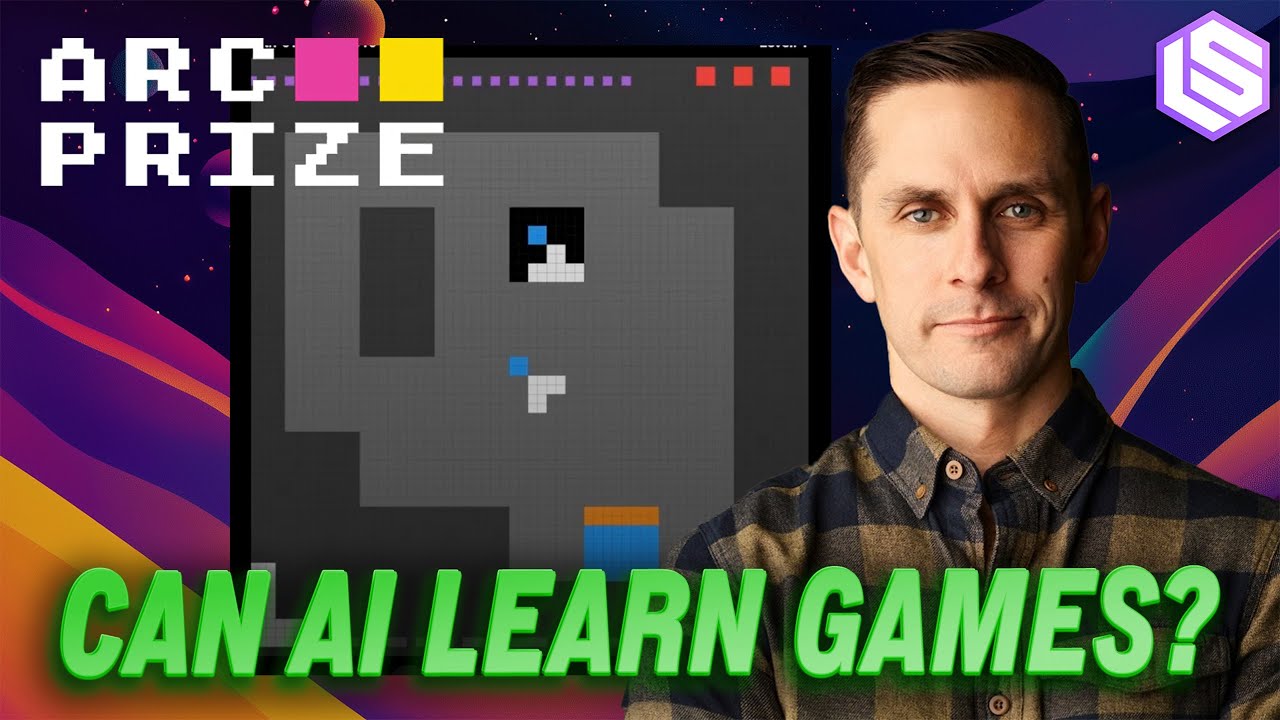
Greg Kamradt, president of ARC Prize Foundation, previews ARC-AGI-3, an interactive reasoning benchmark of 100 novel 2D games designed to measure AI's sample-efficient learning and generalization—matching human learning efficiency. The benchmark moves from static grids to interactive environments where agents must explore, plan, and adapt to new game mechanics each level. Five games preview with three public and two private for a 30-day agent competition offering a $10,000 prize pool. Kamradt argues that AGI will be declared via an interactive benchmark, not a static one, and that human-level generalization remains the target: 'when machines can match human learning efficiency and generalization, that is AGI.' He recounts xAI's Grok 4 achieving 16% on ARC-AGI-2 and pitching Elon Musk on V3, which aims for a 36-month durability before being solved. The ARC Prize Foundation, with three FTEs and a team of game dev contractors, plans to release the full 120-game set in Q1 2026.

The AI Architect: Bret Taylor
Feb 11, 2025 · 1:35:59
Bret Taylor, CEO of Sierra and chairman of OpenAI, recounts engineering AI's future across three eras — rewriting Google Maps' frontend in a weekend (cutting un-gzipped code to 20K), building Sierra's in-house agent platform for consumer brands like Sonos and SiriusXM, and navigating OpenAI's leadership crisis. He argues that AI agents' core abstractions are still pre-React, compares today's agents to jQuery, and predicts that outcome-based pricing will dominate as agents complete jobs rather than assist humans. He urges software engineers to move up the stack toward domain-specific agents and to embrace Rust-like languages for AI-generated code, emphasizing formal verification and safety. Taylor also shares how OpenAI prioritizes mission over product features, and why the relationship with Microsoft remains OpenAI's most important partnership.
2024 Year in Review: The Big Scaling Debate, the Four Wars of AI, Top Themes and the Rise of Agents
Jan 1, 2025 · 1:51:07
In their 100th episode, hosts Alessio and Swyx recap 2024 in AI, arguing that pre-training scaling has hit a wall—backed by Ilya Sutskever and others at NeurIPS—and that inference-time compute (o1, o3) is the new frontier. They dissect the "four wars": data quality (lawsuits vs. synthetic data), GPU haves vs. have-nots (with the middle class dying), multimodality (Sora, Veo 2, Gemini 2.0's native image output), and the LLM OS/agents stack (LangChain, E2B, memory). Market share shifted from OpenAI's 95% to 50-75% as Anthropic and Gemini gained ground; prices dropped ~3 orders of magnitude for same ELO. The episode predicts 2025 as the year agents finally enter production, driven by models like o1 and tools like Devin, and warns that AI will set the skill floor for roles.
[Paper Club] 🍓 On Reasoning: Q-STaR and Friends!
Sep 18, 2024 · 47:12
This episode of Paper Club surveys three reasoning papers — STaR, Quiet-STaR, and V-STaR — arguing that while STaR is foundational for bootstrapping reasoning via rationales and rationalization, Quiet-STaR's attempt to generate rationales at every token yields only marginal gains (5–10% on GSM8K and CQA), and V-STaR's verifier trained with DPO on both correct and incorrect solutions delivers the most practical improvement, beating majority voting. The host explains STaR's two-loop process of generating rationales and rationalizations from wrong answers, highlights examples like a filtering-straw question where human raters evaluated reasoning quality, and notes that STaR on GPT-J 6B achieved human-like step counts in math problems. V-STaR's verifier selects among candidate solutions, scaling with K candidates, and is compared to process reward models from OpenAI's "let's verify step by step."
Powered by PodHood