
Codex
ProductA product discussed on Latent Space.
38 episodes

Orbs: Shifting Coding to Cloud — Quinn Slack, Amp Code
Sep 7, 2026 · 40:14
Quinn Slack, CEO of AMP (spun off from SourceGraph), argues mandatory code review and local dev are dead now that agents run remotely in AMP's new Orbs product. Slack says AMP's 20-person trusted team ships fixes 15 minutes after a log or customer report instead of waiting on review, and has stopped using GitHub issues and pull requests, predicting 'the days of CI as we know it are numbered.' He argues cloud sandboxes with time-limited OIDC tokens are more secure than developer laptops, demos agent-built 'apps' replacing settings screens, and previews 'jellyware'—internal tools anyone can remix with their own agent. He recounts spinning AMP off from SourceGraph—rare since Yammer left Geni in 2009—keeping investors in both companies, and staying profitable without hiring PMs or marketers.

OpenAI’s Vision for the AI Super App — Akshay Nathan, OpenAI
Jul 28, 2026 · 1:10:57
Akshay Nathan, OpenAI's head of core product engineering, explains why the company merged Codex and ChatGPT into a unified agent harness, arguing that the lines between software engineering and knowledge work are blurring. He reveals that Codex unexpectedly gained traction among non-developers at OpenAI, leading to the launch of ChatGPT Work, which shares the same underlying harness but offers opinionated UX differences like sandboxing and Git visibility. Nathan details how artifacts, Sites, plugins, memory, and sub-agents enable users to replace slide decks and spreadsheets with interactive websites, and shares that ChatGPT Work reached 10 million users shortly after launch. He discusses OpenAI's goal to bring useful agents from developers to all knowledge workers, emphasizing that the default model configuration should work for most users while power users can opt into deeper reasoning, Ultra, or multi-agent setups. Nathan also reflects on how AI transforms product development, noting that ideas and taste become the bottleneck when anyone can build, and warns managers not to conflate motion with progress.
Cooking with OpenAI’s Research Chief: AGI, o1, Evals, and Scaling Laws — Mark Chen
Jun 25, 2026 · 41:18
Mark Chen, OpenAI's Chief Research Officer, defends scaling laws and pre-training as far from dead, arguing that reasoning (the bet behind o1) remains underrated and that the field faces an evals crisis requiring fresh benchmarks. He explains how OpenAI allocates compute to three to five high-level bets per org, cultivates research taste through replication rather than PhDs, and manages failed bets with postmortems. Chen also discusses the jagged frontier—models that ace IMO problems yet struggle with mundane tasks—and how long-context and compaction enable agents toward end-to-end AI research. Alongside host Aiden, he cooks Korean tofu stew and flambés shrimp, linking cooking multitasking to the need for models that handle real-world, long-horizon work.

The Agent Cloud: Databricks’ Bet on the Future of AI — Matei Zaharia and Reynold Xin
Jun 24, 2026 · 1:10:06
Databricks cofounders Matei Zaharia and Reynold Xin argue the company is moving beyond the lakehouse into a full data-and-AI operating system, anchored by two new initiatives: Omnigent, an open-source meta-harness for combining coding and enterprise agents, and LTAP, a unified storage layer that gets most HTAP benefits without collapsing query engines. Omnigent provides a common API for agent sessions, files, streams, tool calls, and cancellation, solving portability, collaboration, and security issues across Claude Code, Codex, Cursor, and custom agents. LTAP writes transactional data directly in columnar Parquet format, eliminating brittle CDC pipelines—Reynold jokes CDC means 'continuous data corruption'—and enables instant analytics without overloading the source database. The episode details Databricks’ culture of rapid prototyping, where an engineer built the LTAP prototype without a formal design doc, and the thesis that traditional software will be rewritten once data is in the right place with agents on top. They also cover Mosaic’s shift from general frontier models to specialized fine-tuned models like document parsing, internal agent usage, and security features such…
AI Security After Codex and Claude Code — Zico Kolter & Matt Fredrikson, Gray Swan
Jun 22, 2026 · 1:07:31
Gray Swan cofounders Zico Kolter and Matt Fredrikson explain why AI agents like Codex and Claude Code introduce a new class of security vulnerabilities that traditional cybersecurity cannot address, and present their automated red-teaming system Shade and guardrail model Cygnal as solutions. Prompt injection creates exploits for agents operating on untrusted data, and Shade now outperforms human red teamers at breaking models. The lethal trifecta—untrusted data, private data, and exfiltration—defines the highest risks. In their Human Browser Agent Robustness Challenge, humans ranked fourth among models, with some frontier agents falling for attacks no person would. Bigger models do not automatically become safer, and specialized systems like Cygnal enforce enterprise policies more reliably than prompt engineering. They see AI security evolving toward insurance and compliance, with the first major prompt-injection breach a gray swan—unlikely but visible ahead of time.

Devin’s 80% Moment: Background Agents, 7x PRs, & End of Hand-Held Coding — Walden Yan & Cole Murray
May 28, 2026 · 1:09:33
Walden Yan (Cognition CPO) and Cole Murray (creator of OpenInspect) argue that background agents are becoming critical infrastructure as Devin's merged PRs grew 7x and its share of commits jumped from 16% to 80%. They explain why architecture matters, particularly the decision to separate the agent's brain from the machine (harness out of the box) for security and permissions, and why full VMs beat Docker for running real applications. Testing, they stress, is a harder problem than computer use—requiring orchestration of services, feature flags, and multi-model coordination. Memory remains unsolved, with Devin using auto-generated 'Knowledge' and exploring file-system-like approaches. Both caution against uncontrolled vibe coding, which regresses codebases to the worst engineer's style, and advocate for hybrid frontier/sub-frontier systems to balance cost and capability.

🔬How GPT‑5 derived new results in theoretical physics and quantum gravity — Alex Lupsasca, OpenAI
May 5, 2026 · 1:31:51
Alex Lupsasca, a theoretical physicist at OpenAI and recipient of the 2024 New Horizons Breakthrough Prize, details how GPT-5 and subsequent models derived new results in quantum field theory and quantum gravity, solving problems that had stumped experts for over a year. The work focused on 'single minus' gluon tree amplitudes, long believed to be zero, but which humans discovered might be non-zero in a special kinematic region. GPT-5.2 Pro conjectured a simplified formula for these amplitudes, and an internal OpenAI model later proved it, reducing a factorial number of Feynman diagram terms to a linear number. The AI then autonomously extended the result to graviton amplitudes using the gluon paper as a seed, producing a complete paper draft in under an hour. Lupsasca argues this marks a threshold where AI is superhuman on certain physics tasks, accelerating research by acting as a 'scout' that reduces confusion and suggests next questions. He also discusses challenges including AI slop on arXiv and the need for better verification methods.
⚡️ Competing with ChatGPT and Sierra, building a $10M ARR company — Yasser Elsaid, Founder, Chatbase
May 2, 2026 · 1:00:26
Yasser Elsaid, founder of bootstrapped AI chatbot company Chatbase, discusses how he grew from a side project to $10M ARR in three years, reaching $1M in just 117 days. He explains why he never raised VC, relying instead on product-led growth, self-serve signups, and a content-driven go-to-market strategy. Elsaid shares specific tactics like warm outbound to signed-up users, leveraging LinkedIn virality in early AI days, and now moving toward outcome-based pricing for enterprise customers. He details Chatbase's evolution from a simple RAG chatbot into a 'chief customer officer' that handles support, sales, and onboarding while surfacing business insights from conversations. The episode also covers his transition from Toronto to San Francisco, his hiring philosophy favoring results-oriented engineers, and his daily use of both Claude Code and Codex for development.
AI-Native Engineering: 100% adoption, 5x search throughput, unlimited tokens — Mikhail Parakhin
Apr 22, 2026 · 1:14:30
Shopify CTO Mikhail Parakhin details how the company achieved near 100% AI tool adoption, driven by a December 2025 inflection point where model quality triggered exponential token consumption. He argues token budgets matter only with strong critique loops: running multiple parallel agents without communication wastes tokens, while agentic PR review using large models—like GPT-5.4 Pro or Gemini Deep Think—reduces bugs even though latency increases. Parakhin unveils Tangle, Shopify's third-generation ML workflow system with content-based caching that eliminates duplicate computation across teams, and Tangent, an auto-research loop that optimizes pipelines—boosting search throughput from 800 to 4,200 QPS on the same hardware. SimGym simulates shoppers using decades of merchant data and browser-based agents to predict conversion changes, achieving 0.7 correlation with add-to-cart events. Shopify uses Liquid AI (non-transformer architecture) for sub-30ms query understanding and long-context tasks like catalog categorization, distilling larger models into Liquid for high-throughput batch jobs.
Extreme Harness Engineering: 1M LOC, 1B toks/day, 0% human code or review — Ryan Lopopolo, OpenAI
Apr 7, 2026 · 1:17:54
Ryan Lopopolo of OpenAI's Frontier team details his team's extreme experiment in harness engineering: building a 1M LOC internal Electron app with zero human-written or reviewed code, relying instead on Codex agents that process 1B tokens daily ($2-3k/day). He argues that humans are the bottleneck and that teams should encode non-functional requirements into specs, skills, and observability tooling rather than prompting agents to 'try harder.' The result is Symphony, a ghost library spec and Elixir reference implementation that automates the entire pull-request lifecycle, including self-review and merge. Lopopolo explains how the team scales by treating software as agent-legible text, using worktrees for multi-agent collaboration, and feeding agent mistakes back into the repository via docs like core-beliefs.md. He also discusses Frontier's enterprise platform for safe agent deployment, noting that success depends on giving agents full context—even company culture and inside jokes—so they can act as full teammates.
Dreamer: the Agent OS for Everyone — David Singleton
Mar 20, 2026 · 1:04:23
David Singleton, former Stripe CTO, introduces Dreamer, a consumer platform for discovering, building, and using AI agents and agentic apps centered on a personal Sidekick that acts as both companion and kernel-like traffic cop. He demonstrates building a conference schedule app in 25 minutes via natural language, a ski trip app that splits expenses, and tools like Gmail, Google Search, and live sports data feeds. Dreamer features an open tool ecosystem where builders get paid, a private waitlist skip at dreamer.com/latentspace, and a Builder-in-Residence program with a $10,000 prize for the best tool by mid-April. Singleton explains the OS model with Sidekick as kernel and agents as users enforcing data isolation and cross-agent coordination only through Sidekick. He shares insights on tiny-team building (six-person core, 17 total), hiring engineers who collaborate with coding agents, and LLMs' current lack of taste and creativity.

⚡️Monty: the ultrafast Python interpreter by Agents for Agents — Samuel Colvin, Pydantic
Mar 14, 2026 · 34:02
Samuel Colvin joins Shawn Wang to introduce Monty, Pydantic's ultrafast Python interpreter built with AI for agents, positioning it as a lightweight, secure alternative to sandboxes for code execution. Monty runs inside the same process, achieving sub-microsecond latency (800 nanoseconds in a hot loop), versus over a second for cloud sandboxes. Colvin explains the inspiration came from conversations at Anthropic about type safety's critical role in AI tool calling, and how Monty fills the gap between simple tool calling and full sandboxes. Monty is not full CPython—it lacks third-party library support and some standard library modules—but covers essential built-ins, implemented largely by LLMs that Colvin calls 100x faster for tasks where internal and external APIs are well-known, unit tests are trivial, and there's no API bikeshedding. He demonstrates a Pydantic AI agent using Monty to scrape LLM pricing from websites, with type checking built into the runtime so only permitted host functions (e.g., Playwright, Beautiful Soup wrappers) can be called. Colvin also shares his workflow using Claude Code, Codex, and Gemini CLI in combination for code review and implementation, and…

Agent Inference at the "Speed of Light" — How NVIDIA moves like a $4.3 Trillion Startup
Mar 8, 2026 · 1:26:00
NVIDIA's Nader Khalil and Kyle Kranen join Swyx and Vibhu to explain how the company moves like a $4.3 trillion startup through speed-of-light (SOL) first-principles thinking, agent security boundaries, and the Dynamo inference engine. They argue agents should only do two of three things (files, internet, code) to prevent vulnerabilities, and detail Brev's acquisition to improve developer UX with one-click GPU access and DGX Spark integration. Kyle describes Dynamo as a data center scale inference engine that optimizes serving by scaling out, using prefill/decode disaggregation, Kubernetes-based scheduling, and model-hardware co-design to improve cost, latency, and quality. The episode covers SOL's role in creating urgency, long-context limits and potential 'unhobblers' like multi-head latent attention, and the shift toward CLI-first agent workflows for enterprise tools.
Cursor's Third Era: Cloud Agents — ft. Sam Whitmore, Jonas Nelle, Cursor
Mar 6, 2026 · 1:11:18
Cursor's Sam Whitmore and Jonas Nelle detail their Cloud Agents launch, where agents get full cloud VMs to onboard repos, run code, and test changes end-to-end before returning PRs with demo videos and remote desktop access. The model decides whether to test (with /no-test to skip and /repro for bug reproduction videos). Videos cut review time by letting humans watch 20-second clips instead of giant diffs. Cursor supports parallel model swarms via best-of-N—running multiple models head-to-head on the same prompt—and subagents for context management, plus a long-running 'grind mode' for multi-day tasks. They predict cloud agents will surpass local agents in volume by year-end, driving per-developer spend to thousands per month and creating new bottlenecks in CI/CD and production pipelines.
Why Every Agent Needs a Box — Aaron Levie, Box
Mar 5, 2026 · 1:16:58
Aaron Levie, CEO of Box, argues that every AI agent needs a dedicated data repository—a 'box'—to effectively access enterprise content, and that deploying autonomous agents at scale requires new infrastructure for governance, identity, and security. He contrasts the rapid adoption of coding agents, which benefit from full codebase access and technical users, with the slower enterprise rollout where access controls, messy data, and context engineering pose major hurdles. Levie details Box's internal evals showing 15-point jumps in model performance and emphasizes the need for agents to judge when to stop searching. He discusses moving from read-only to read-write agent workflows, the challenge of keeping documentation current, and his hands-on founder approach to steering a 3,000-person public company through the AI transformation.
Measuring Exponential Trends Rising (in AI) — Joel Becker, METR
Feb 27, 2026 · 1:05:12
Joel Becker of METR explains the organization's model evaluation and threat research to assess whether AI could pose catastrophic risks, detailing their time horizon chart measuring task difficulty in human time at 50% reliability. He describes how tasks are selected for economic relevance and auto-gradability, and why time horizon is often misinterpreted as agent runtime. The episode covers Opus 4.5's surprising jump, challenges redoing developer productivity RCTs as workflows change, and why current models aren't yet catastrophically dangerous. Becker discusses potential capability explosions if R&D loops fully automate, links between compute growth slowdowns and slower capability progress, and his Manifold trading story driven by a charity market he could influence. He previews METR's 2026 plans for monitoring and risk assessment, and their hiring.

Dylan Patel Explains the AI War While Cooking | In-Context Cooking
Feb 26, 2026 · 55:13
Dylan Patel, CEO of SemiAnalysis, argues hyperscalers like Google, Amazon, and Meta will sacrifice all profits to build AI infrastructure, spending $180–$200 billion in capex this year alone, because the AI adoption explosion—Claude Code driving 4% of GitHub commits in one month, Anthropic adding $2.5 billion monthly revenue—makes it a Pascal's wager: spend or die. He details how Taiwan's semiconductor geopolitics create endgame scenarios, from a KMT win placating China to full invasion, with TSMC's output critical. Patel explains Nvidia's paranoid founder Jensen Huang is responding to vertical integration threats from hyperscalers by diversifying into chips like CPX and Groq, but warns moats are shallow. The real bottleneck in AI progress? Semiconductors themselves: fabs take years to build, and no one can buy enough GPUs through 2028. He also predicts a massive AI backlash from the public and financial markets, as capital consumption outpaces revenue and labor displacement accelerates.

Claude Code for Finance + The Global Memory Shortage: Doug O'Laughlin, SemiAnalysis
Feb 24, 2026 · 2:07:40
Doug O'Laughlin, SemiAnalysis founder, explains his Claude Code awakening in December 2024: Anthropic's Opus 4.5 one-shotted tasks that used to take 24 hours, leading him to predict Claude Code will write 25–50% of all GitHub code by year-end (already 4% of commits in two weeks). He argues this marks the death of Excel and Bloomberg for analysts—'you can just do things'—but warns of a 'hygiene' crisis as junior analysts lose meta-learning. On the semiconductor side, O'Laughlin details a severe memory squeeze: HBM demand consumes 4× the DRAM capacity, DRAM prices could double again, and CXL is reviving as a workaround. He compares AI infrastructure buildout to the railroad boom (25% of U.S. gross fixed capital investment) and says Microsoft faces an innovator's dilemma—renting GPUs to 'barbarians at the gate' while its own office franchise is disrupted by Claude Code. Google's TPU v7 enjoys a temporary TCO advantage, but Nvidia's supply chain dominance (Jensen doing shots with SK and Samsung) will reassert with Rubin. O'Laughlin also reflects on his 2,800-mile Continental Divide Trail hike as essential self-mastery.
Inside AI’s $10B+ Capital Flywheel — Martin Casado & Sarah Wang of a16z
Feb 19, 2026 · 55:31
Martin Casado and Sarah Wang of a16z argue that AI’s capital flywheel—where model labs translate funding directly into capability gains and revenue growth in weeks—is creating a new financing playbook that blends venture and growth, with rounds acting as compute contracts. They warn that frontier labs like Anthropic can potentially raise more money than the entire app ecosystem built on their APIs, allowing them to outspend and consume those layers. The episode examines the AGI vs. product dilemma in GPU allocation, the war for talent where $10M+ packages break early-stage founder math, and Cursor as a case study of building up from the app layer while training down into its own models. They also identify “boring” enterprise software as the most underinvested opportunity and note that robotics lacks a ChatGPT moment that would justify current funding levels.

⚡️ Prism: OpenAI's LaTeX "Cursor for Scientists" — Kevin Weil & Victor Powell, OpenAI for Science
Jan 27, 2026 · 36:00
Kevin Weil (VP of OpenAI for Science) and Victor Powell (Prism product lead) launch Prism, a free AI-native LaTeX editor that embeds GPT-5.2 directly into the scientific writing workflow, eliminating copy-pasting between ChatGPT and Overleaf and turning weeks of LaTeX formatting into minutes of natural language instruction. The origin story reveals Kevin discovered Victor's stealth company Cricket on Reddit and DM'd him to bring the team into OpenAI. In the live demo, Prism proofreads papers paragraph by paragraph, converts a whiteboard commutative diagram photo into TikZ code, generates 30 pages of general relativity lecture notes in seconds, and verifies complex symmetry equations in parallel chat sessions. They argue that LaTeX typesetting is the bottleneck diverting scientists from actual research, and that unlimited free collaboration and multi-line diff generation make Prism a 'tool for thought' rather than just a publishing tool. Kevin predicts 2026 will be for AI in science what 2025 was for AI in software engineering — a year when it becomes essential. The discussion also covers OpenAI's approach to accelerating science broadly, including the role of robotic labs and…

[State of Post-Training] From GPT-4.1 to 5.1: RLVR, Agent & Token Efficiency — Josh McGrath, OpenAI
Dec 31, 2025 · 27:34
Josh McGrath, an OpenAI post-training researcher, states that real post-training innovation lies in data quality and signal trust, not optimization methods, with RLVR and token efficiency central. He moved from pre-training (3% compute gains) to post-training (40% behavior change), describes the infrastructure chaos of RL runs, and cites GRPO from DeepSeek Math as underappreciated for providing verifiable reward signals. GPT-5 to GPT-5.1 bumped evals while slashing tokens, emphasizing token efficiency over wall-clock time. The shopping model features interruptibility and chain-of-thought transparency, and personality toggles (Anton vs Clippy) are a key differentiator. For long context, he argues agents with graph walks may be more important than 10M-token windows. He concludes that the education system fails to produce people skilled in both distributed systems and ML research, a critical combination as bottlenecks shift.
[State of RL/Reasoning] IMO/IOI Gold, OpenAI o3/GPT-5, and Cursor Composer — Ashvin Nair, Cursor
Dec 30, 2025 · 45:13
Ashvin Nair, now ML lead at Cursor, traces his path from Berkeley robotics and an OpenAI Dota-era internship to OpenAI's reasoning team (which grew from a dozen to 300+ people) and explains why IOI Gold in 2022 felt like solving AI but didn't change the world—because RL doesn't generalize beyond training distribution. He argues most RL research from 2017-2022 overfit to benchmarks, rewarding complex ideas over simple ones that scale. At Cursor, he sees a unique opportunity for continual learning with policy updates every two hours and product-model co-design, keeping engineers in the loop instead of context-switching. His bet is that the next paradigm shift is continual learning with infinite memory: models experience something once and never forget it, storing millions of deployment tokens in weights without overloading capacity.

Steve Yegge's Vibe Coding Manifesto: Why Claude Code Isn't It & What Comes After the IDE
Dec 26, 2025 · 37:25
Steve Yegge argues that vibe coding—using multi-agent AI workflows—will replace traditional IDEs by January 1, calling anyone still using an IDE a 'bad engineer.' He claims Claude Code, Cursor, and the 2024 stack are already obsolete, predicting agent orchestration dashboards (like his VC project) will manage fleets of agents. Yegge highlights that senior engineers with 12–15 years of experience are the most resistant, but their productivity will be eclipsed by vibe coders. He warns that merging code becomes a new wall as agents produce 10x more code, citing one company's solution of one engineer per repo. Yegge also notes the chaos inside AI labs (OpenAI, Anthropic, Google) as they scale, and believes open‑source models will approach frontier capability within a year.
⚡️GPT5-Codex-Max: Training Agents with Personality, Tools & Trust — Brian Fioca + Bill Chen, OpenAI
Dec 26, 2025 · 27:46
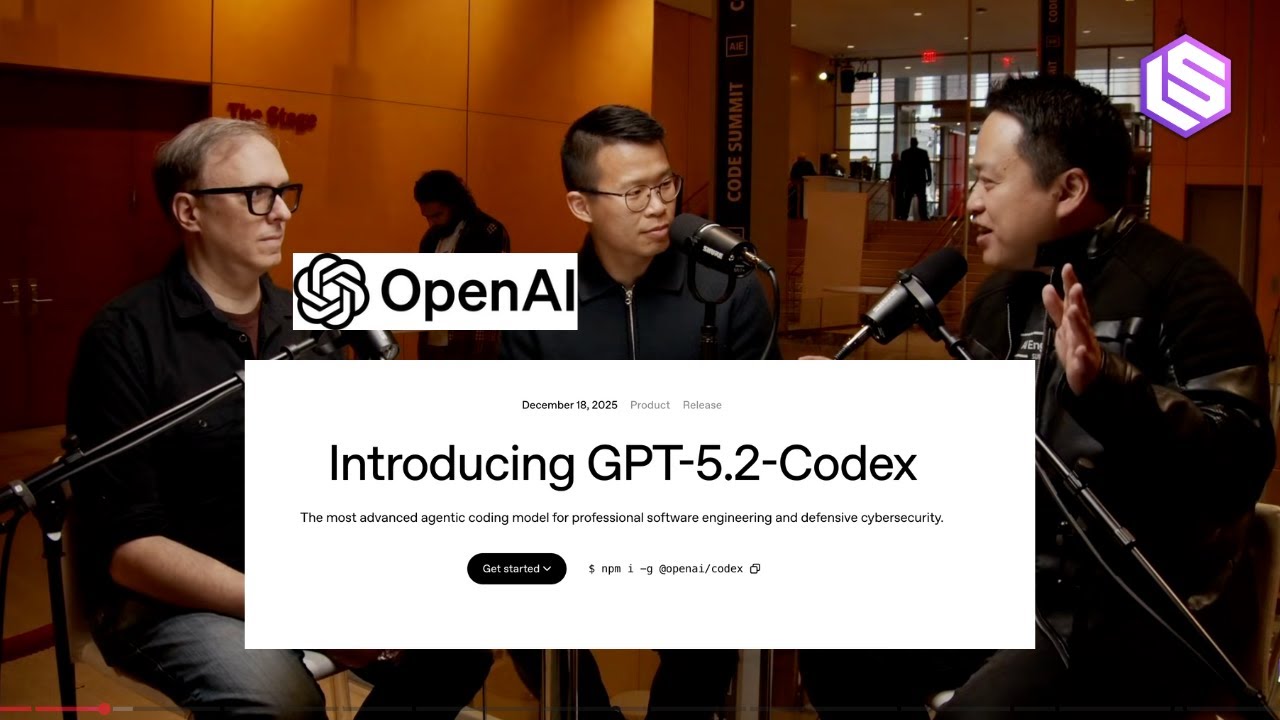
OpenAI’s Brian Fioca and Bill Chen discuss the launch of Codex Max, a long-running coding agent designed to work 24+ hours, manage its own context, and spawn sub-agents. They reveal how GPT-5 training prioritized personality traits—communication, planning, and self-checking—to build developer trust, and how Codex develops tool habits like preferring 'rg' over 'grep'. The abstraction layer is shifting from models to full-stack agents, enabling partners to plug Codex into tools like VS Code or Zed. They highlight applied evals that measure real-world impact over academic benchmarks, and the need for multi-turn eval APIs. Their 2026 vision: coding agents trusted enough to handle the hardest refactors at any company, not just top-tier firms, and general enough to automate personal workflows like organizing desktops or email.

⚡️ 10x AI Engineers with $1m Salaries — Alex Lieberman & Arman Hezarkhani, Tenex
Nov 19, 2025 · 27:11
Tenex co-founders Alex Lieberman and Arman Hezarkhani explain how they compensate AI engineers by story points instead of hours, enabling some to earn over $1 million annually while delivering 10x productivity gains. The model emerged after Arman downsized his previous company Parthian's engineering team by 90% yet saw a 10x increase in production-ready software output by re-architecting with AI. They avoid gaming by hiring engineers who are long-term selfish or love coding, and pair them with technical strategists incentivized on account retention. Example projects include building a retail camera prototype in two weeks and a trivia app that hit #20 on the App Store in a month. Their default stack is TypeScript with React and Express, and they switch between coding agents like Claude Code and Codex based on daily performance. They identify human capital as their main constraint and context engineering or entropy reduction as the core challenge for autonomous AI engineers.

⚡ Inside GitHub’s AI Revolution: Jared Palmer Reveals Agent HQ & The Future of Coding Agents
Nov 10, 2025 · 35:52
Jared Palmer, SVP at GitHub and VP at CoreAI at Microsoft, traces his journey from building v0 at Vercel—a focused Next.js coding agent that grew from $1M ARR to millions more after adding chat—to launching Agent HQ at GitHub Universe, a collaboration hub for developers and coding agents. He explains how v0's success came from laser-focus on one stack and framework, and how GitHub's 180M developers enable scaling agent-based workflows. Palmer discusses model strategy tradeoffs (composite vs. branded models), the challenge of repo setup and infrastructure reliability, and using coding agents for non-coding tasks like automating Excel workflows. He reveals Stacked Diffs as GitHub's top feature request, with active exploration after previous attempts, and outlines his vision for seamless AI integration across GitHub, VS Code, and Actions, including features like resolving merge conflicts with AI.
Terminal-Bench 2.0: the most impt coding agent benchmark of 2025 gets a v2! Launch + Q&A w/ founders
Nov 8, 2025 · 35:01
Terminal-Bench co-creators Mike Merrill, Alex Shaw, and collaborators Andy Konwinski, Ludwig Schmidt, and Aatash launch Terminal-Bench 2.0, an 89-task coding benchmark with rigorous human and LM-assisted verification to test agent performance on real-world tasks like designing DNA primers and installing Windows 3.11. They reflect on Terminal-Bench 1's problems—easy tasks and reproducibility—and detail spending 300 hours manually auditing each task. They introduce Harbor, an open-source package for running sandboxed agent rollouts, standardizing task format and integrating with agents like Codex and Claude Code. Aatash shows using Harbor to generate thousands of training traces for DataComp Agent, running 1,000 parallel sandboxes. Future plans include expanding to scientific computing.

Terminal-Bench: Pushing Claude Code, OpenAI Codex, Factory Droid, et al to the limits
Oct 18, 2025 · 35:27
Alex Shaw and Mike Merrill, creators of Terminal-Bench, explain how their coding agent benchmark became an industry standard adopted by Anthropic, OpenAI, and leading agent companies. They bet on terminal-based interaction over GUI because text is the modality that works best with models, and designed tasks as containerized environments with instructions and test scripts. Nicholas Carlini at Anthropic became an early champion, leading to Terminal-Bench being featured on Claude’s model card without notice. They built the minimal Terminus agent to isolate model capabilities from agent optimizations, and their framework adapts existing benchmarks like SWE-bench. Future plans include cloud hosting, multi-dimensional evaluation incorporating cost and economic value, and enabling RL post-training on benchmark tasks.

DevDay 2025: Apps SDK, Agent Kit, MCP, Codex and why Prompting is More Important than Ever
Oct 7, 2025 · 44:52
Sherwin Wu and Christina Huang from OpenAI's platform team discuss the new AgentKit suite and Apps SDK, arguing that visual agent builders and prompt optimization remain critical for production AI. They detail AgentKit's components—Agent SDK, visual Builder, Evals, and Tool Registry—and how Apps SDK inverts the website-chatbot paradigm by embedding apps inside ChatGPT. OpenAI adopted Anthropic's MCP protocol for tool connectivity, and the team dogfoods these tools for their own customer support at openai.com. They explain that automated prompt optimization and evaluation pipelines are essential for scaling agents, and share how Codex is used internally for code generation and PR reviews. The episode also covers the Service Health Dashboard for real-time API SLO tracking, reflecting OpenAI's reliability investments.

The antidote to AI fatigue — Answer.ai Solveit
Oct 2, 2025 · 55:26
Jeremy Howard, Eric Ries, and Johno Whitaker join host Alessio to present Answer.ai's Solveit platform, arguing that human-in-the-loop, step-by-step AI collaboration outperforms fully autonomous agents for complex coding and writing tasks. The 12-person team built their own integrated development and deployment system, eschewing cloud vendors. Solveit provides each user a persistent Linux Docker container with a Jupyter-like interface where the AI can see all steps, enabling immediate error correction and iterative improvement. Johno demonstrates building a perfume scent search engine in under an hour; Eric shows how he uses Solveit to manage writing his book 'Incorruptible', incorporating test reader comments and fact-checking sections. Jeremy reveals they turned Andrej Karpathy's GPT tokenizer video into a polished blog post. The Solveit course launches October 20th at solve.it.com, teaching this philosophy beyond just the tool.

Amp: The Emperor Has No Clothes
Sep 25, 2025 · 1:21:59
Quinn Slack (CEO) and Thorsten Ball (Amp Dictator) from Sourcegraph discuss Amp Code, a coding agent that ships 15x/day with no code reviews. They explain the strategic pivot from Cody to Amp, emphasizing that building the best coding agent trumps everything else. The team dogfoods Amp internally, using it to build itself, and maintains both a VS Code extension and CLI, with a 50/50 internal split. They argue that model choice is becoming less important than the harness around the model, and they reject features like prompt enhancers, custom subagents, and MCP servers as not adding value. Common failure modes include outsourcing thinking but not typing and using agents without proper context engineering. They predict async agents running 24/7 will dominate, and they target early adopters willing to adapt their codebases and workflows for maximal agent effectiveness.

Greg Brockman on OpenAI's Road to AGI
Aug 15, 2025 · 1:08:37
Greg Brockman, OpenAI co-founder and president, explains how GPT-5's hybrid reasoning and aggressive pricing advance the road to AGI, while releasing GPT-OSS for open source. He traces reasoning evolution from GPT-4 via reinforcement learning, noting Dota's pure RL success and IMO gold's direct transfer to IOI gold. Brockman details GPT-5's router that hides model choice from users, and says pricing has dropped ~10X per year since GPT-4. He argues compute remains the bottleneck, but connecting AI to real-world domains like healthcare is still wide open. Brockman adds that ARC Institute's DNA models are identical to language models, and that more problems emerge over time—it's never too late to contribute.

The AI Agenda: GPT5 leaks and the business of AI News — Steph Palazzolo, The Information
Aug 6, 2025 · 1:14:36
Steph Palazzolo, AI journalist at The Information, explains how she covers the secretive AI industry, from OpenAI's GPT-5 to the inference market where startups like Modal raise billions. She reveals that inference providers are essentially GPU resellers facing margin pressure, and that GPT-5's performance will signal whether pre-training scaling or reinforcement learning drives progress. She critiques Meta's super intelligence ambition as misaligned with its ad-revenue business, and details the talent war with rumored hundred-million-dollar offers from Meta to poach researchers. Palazzolo also discusses the Windsurf acqui-hire backlash, the rise of coding agents like Claude Code, and how journalists protect sources while navigating leaks from CEOs like Sam Altman.

Cline: The Collaborative AI Coder
Jul 16, 2025 · 1:15:44
Saoud Rizwan and Pash from Cline join to explain why their open-source coding agent uses a Plan + Act paradigm — having models explore and plan before executing — pioneered before competitors like Claude Code. They argue that "RAG is a mind virus" and "Fast Apply got bitter lesson'd" as frontier models now achieve sub-5% diff edit failure rates, making layered workarounds obsolete. Cline's bring-your-own-API-key model avoids inference markups, with enterprise features driven by Fortune 5 companies asking for security and ROI insights. The MCP ecosystem grew via Cline's marketplace (150+ servers, top ones with hundreds of thousands of downloads), though monetization and security remain open questions. They detail how Plan mode extracts user intent and Act mode auto-approves, how context engineering prioritizes agentic file exploration over retrieval, and why they stayed a VS Code extension rather than fork — to focus solely on the agentic loop.

Scaling Test Time Compute to Multi-Agent Civilizations — Noam Brown, OpenAI
Jun 19, 2025 · 1:17:47
Noam Brown, OpenAI researcher behind Cicero and reasoning models, joins hosts Alessio and Puix to discuss how test-time compute scaling drives multi-agent AI and the limits of the system 1/2 analogy. He explains that his Diplomacy bot Cicero reached top 10% of humans in 2022, and later he won the 2025 world championship. Brown argues that reasoning models like o3 succeed in unverifiable domains (e.g., Deep Research) and that harnesses and routers will be washed away by scale. He reveals OpenAI's multi-agent team is pursuing a principled approach, not heuristic, and envisions AI civilizations collaborating. He also shares his coding stack (Codex, Windsurf) and predicts test-time compute will hit cost and wall-clock bottlenecks.

The AI Coding Factory
May 29, 2025 · 59:23
Factory.ai co-founders Eno Reyes and Matan Grinberg join Latent Space to explain their vision for autonomous software engineering droids that handle everything from code generation to incident response for enterprises. They met at a Langchain Hackathon in 2023, and within eight days both quit their jobs to start Factory. The platform is browser-based, not IDE-based, because they argue the optimal UI for a world where humans write less code will not evolve from the IDE. They focus on enterprise codebases, citing a large migration that took from four months to three and a half days. Key design decisions include a delegation model where agents ask clarifying questions, proactive context gathering via synthetic insights, and usage-based pricing tied to token efficiency. They also discuss why SWE-Bench is dead for their use case, the challenge of model post-training biases toward CLI tools, and their need for 'junior Enos' in go-to-market roles.

Tiny Teams: $6m ARR, 5m users with 4 employees — Sid Bendre, Oleve (Quizard AI/Unstuck AI)
Apr 23, 2025 · 42:59
Sid Bendre of Oleve (formerly Quizzer AI and Unstuck AI) explains how his four-person team built $6M ARR and 5M users across multiple consumer apps. Starting with Quizzer AI in January 2023, a viral TikTok gained 10K users in 30 hours; by August 2024, Unstuck AI hit 1M users in nine weeks. The company has been profitable since its first nine months. Bendre describes their platform engineering strategy: product engineers own individual apps while a platform team builds reusable systems, including internal shadow-org agents for growth and marketing. He shares technical hacks like using LaunchDarkly feature flags to load-balance across Azure OpenAI endpoints and a de-indexer for Azure AI Search to manage costs. The key engineering principle is deterministic LLM workflows—classifying user intent then routing to pre-built deterministic flows—rather than open-ended agent tool use.

Is finetuning GPT4o worth it?
Aug 22, 2024 · 1:01:16
Ali Pullen, founder of Cosine, discusses Genie, an AI software engineering colleague that achieved 30% on SWE-Bench and 43.8% on SWE-Bench Verified via fine-tuning GPT-4o on billions of tokens of synthetic data. Cosine built Genie by training on the process of software engineering—not just working code—using synthetic runtime errors and a self-improvement loop. The agent follows a four-stage workflow: code retrieval (66% accuracy), planning, writing diffs, and running CI tests. Pullen reveals that model performance degrades linearly beyond 60K tokens in the context window, and that OpenAI dynamically sizes LoRA adapters to handle Cosine's massive dataset. He explains why Genie isn't on the SWE-Bench leaderboard (refusing to publish trajectories to prevent distillation) and outlines plans to scale the dataset and fine-tune on customer codebases for personalized performance.
Powered by PodHood