
Perplexity
ProductA product discussed on Latent Space.
8 episodes

⚡️Context Graphs: according to the authors — Jaya Gupta, Ashu Garg, Foundation Capital
Feb 4, 2026 · 33:44
Jaya Gupta and Ashu Garg of Foundation Capital introduce Context Graphs—the institutional memory of the 'why' behind business decisions, captured through decision traces of exceptions, overrides, and precedents that AI models often miss. They argue these graphs will become the defensible moat for the next generation of applied AI companies and Systems of Agents, citing early implementations at Player Zero, Olive, and Tesserae. The hosts distinguish Context Graphs from mere metadata or data meshes, emphasizing they emerge organically from automating specific workflows rather than as universal enterprise schemas. They predict that by 2026, hundreds of Context Graphs will be in production, a standard enabling stack will emerge, and the industry will shift from debating definitions to extracting value from the captured decision traces.
⚡️ Building the AI Hardware Engineer with Matthias Wagner, Co-founder of Flux
Nov 22, 2025 · 49:03
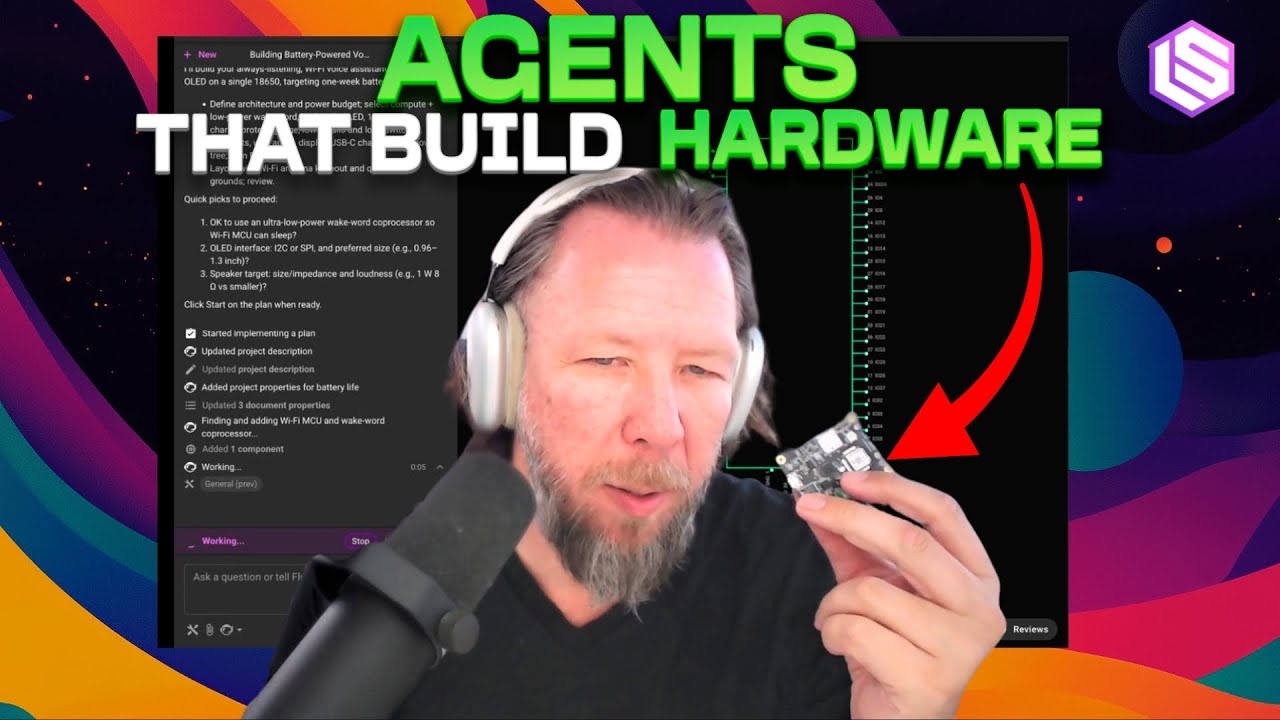
Matthias Wagner, CEO of Flux.ai, describes building the "AI hardware engineer" that turns product briefs into manufacturable PCB designs in under 30 minutes. After leaving Meta in 2019, Wagner built a browser-based collaborative CAD tool from scratch, designed as a reinforcement learning environment. The emergence of LLMs and reliable tool calling let Flux's agents search component libraries, check pricing and availability, and execute complex designs autonomously. In a live demo, Wagner designs a battery-powered Alexa-like device with ESP32, microphones, OLED display, and speaker in about 25 minutes. Flux now has 7,000 paying customers, growing 26x year over year, and Wagner envisions eventually letting users prompt full hardware products like smartphones into existence, claiming the cost of custom manufacturing is plummeting.

AI is Eating Search
Jul 23, 2025 · 56:22
Robert McCloy of Scrunch AI argues that AI is replacing web browsing, not just search, as consumers prefer ChatGPT and similar tools over traditional browsing. He explains that AI search platforms still rely on traditional search under the hood, but re-rank results based on metadata clarity—so clickbait titles fail while descriptive content wins. Prompt injection works currently but is a temporary tactic; the durable strategy is clear, structured content with server-side rendered HTML because AI tools don't execute JavaScript. Scrunch helps brands optimize for platforms like ChatGPT, Perplexity, and Meta AI; customer Clerk saw a 6x traffic increase and 9x conversion lift from AI-referred visitors. Robert predicts the future is about 'agent experience'—optimizing how AI systems interact with your content to serve end users directly.
⚡️Anthropic vs Cognition on Multi-Agents: A Breakdown with Dylan Davis
Jul 5, 2025 · 27:11
Dylan Davis from Gradient Labs breaks down the Anthropic vs Cognition multi-agent debate, arguing both blog posts are right for different use cases. Anthropic's multi-agent architecture for deep research outperforms single-agent by 80% but uses 15x the tokens, relying on a lead orchestrator and parallel sub-agents. Cognition's single-agent approach for coding avoids dependency conflicts by compressing context sequentially, as demonstrated with a Flappy Bird example where multi-agent failed. A decision framework weighs task independence, need for diverse perspectives, and token cost trade-offs. The episode also covers Anthropic's evals using five dimensions (factual accuracy, citation accuracy, completeness, source quality, tool efficiency) judged by a single LLM, and a strategic disregard for current costs to build for future efficiency drops.
Snipd: The AI Podcast App for Learning — with CEO Kevin Ben-Smith
Mar 14, 2025 · 1:17:46
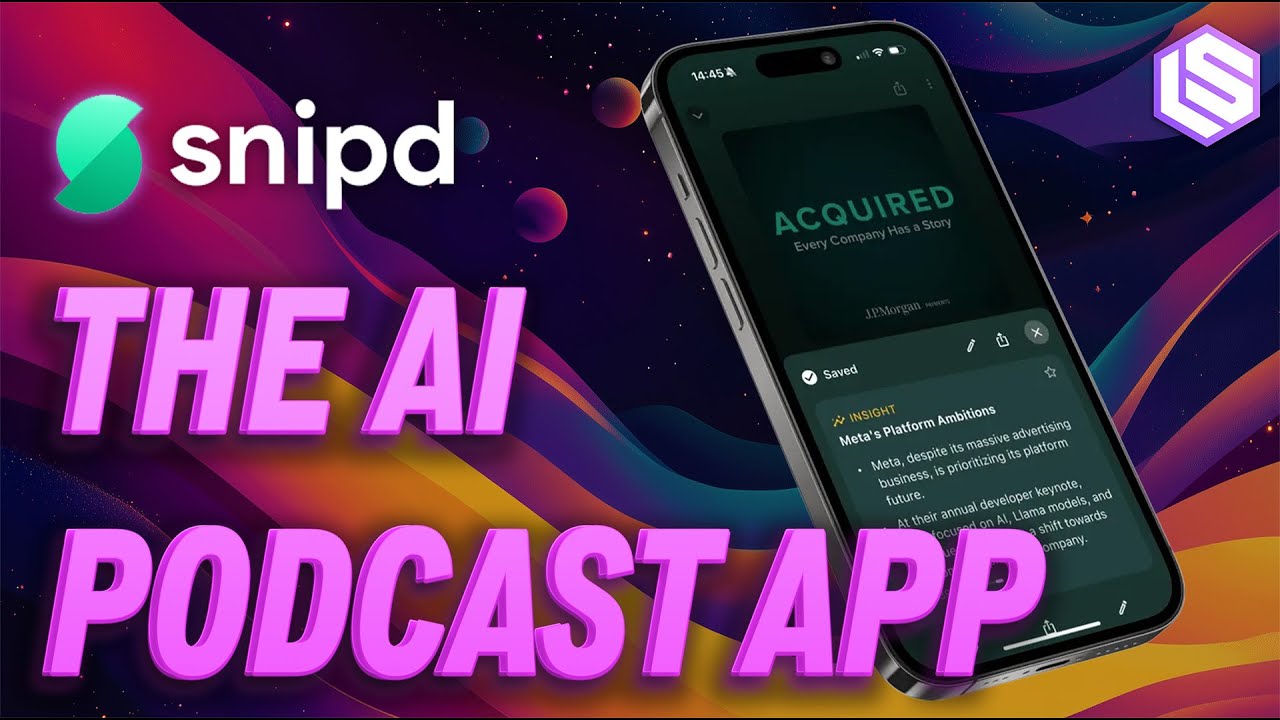
Snipd CEO Kevin Ben-Smith joins Swyx to explain how the AI-powered podcast app turns passive listening into active learning. Snipd transcribes and diarizes episodes, generates chapters, identifies mentioned books, and summarizes insights on demand — all with a four-person team. Kevin describes moving from self-hosted open-source models (Wave2vec, Pyannote) to a mix of Whisper, OpenAI, Google Gemini, and Perplexity APIs, balancing cost against the need for predictable batch processing vs. real-time user requests. He details technical hurdles like dynamic content resyncing (building a 'Shazam for podcasts') and using LLMs as judges to filter hallucinated book recommendations. The episode also covers Snipd's origin as a hackathon-winning podcast search tool, Swyx's own switch from Overcast, and Kevin's vision for voice-driven post-episode reflection and AI-assisted discovery as the next frontier.
2024 Year in Review: The Big Scaling Debate, the Four Wars of AI, Top Themes and the Rise of Agents
Jan 1, 2025 · 1:51:07
In their 100th episode, hosts Alessio and Swyx recap 2024 in AI, arguing that pre-training scaling has hit a wall—backed by Ilya Sutskever and others at NeurIPS—and that inference-time compute (o1, o3) is the new frontier. They dissect the "four wars": data quality (lawsuits vs. synthetic data), GPU haves vs. have-nots (with the middle class dying), multimodality (Sora, Veo 2, Gemini 2.0's native image output), and the LLM OS/agents stack (LangChain, E2B, memory). Market share shifted from OpenAI's 95% to 50-75% as Anthropic and Gemini gained ground; prices dropped ~3 orders of magnitude for same ELO. The episode predicts 2025 as the year agents finally enter production, driven by models like o1 and tools like Devin, and warns that AI will set the skill floor for roles.

Is finetuning GPT4o worth it?
Aug 22, 2024 · 1:01:16
Ali Pullen, founder of Cosine, discusses Genie, an AI software engineering colleague that achieved 30% on SWE-Bench and 43.8% on SWE-Bench Verified via fine-tuning GPT-4o on billions of tokens of synthetic data. Cosine built Genie by training on the process of software engineering—not just working code—using synthetic runtime errors and a self-improvement loop. The agent follows a four-stage workflow: code retrieval (66% accuracy), planning, writing diffs, and running CI tests. Pullen reveals that model performance degrades linearly beyond 60K tokens in the context window, and that OpenAI dynamically sizes LoRA adapters to handle Cosine's massive dataset. He explains why Genie isn't on the SWE-Bench leaderboard (refusing to publish trajectories to prevent distillation) and outlines plans to scale the dataset and fine-tune on customer codebases for personalized performance.

[LLM Paper Club] Llama 3.1 Paper: The Llama Family of Models
Jul 29, 2024 · 1:23:46
This episode examines Meta's Llama 3.1 paper, detailing the 405B dense model, its scaling laws grounded on the ARC reasoning benchmark rather than perplexity, and the decision to train on 15 trillion tokens. Vibhu explains the training infrastructure: 16,000 H100s over 54 days with 419 interruptions, 78% from GPU hardware failures. Eugene Yan walks through the synthetic data pipeline—using Llama 2 for filtering, stepwise reward models, and Monte Carlo tree search to improve reasoning traces. Hassan shares building LlamaTutor.com with Together API, serving 4,000 visitors and 5,900 requests for about $12. The group also discusses quantization trade-offs (larger models degrade less), inference provider variability (Groq's non-deterministic temperature zero), and compares Llama 405B's performance to GPT-4o and Claude.
Powered by PodHood