
YouTube
ProductA product discussed on Latent Space.
7 episodes

Anthropic’s Felix Rieseberg on AI Coworkers, Local-First Agents, and the Future of Knowledge Work
Mar 17, 2026 · 1:27:34
Anthropic's Felix Rieseberg explains how Claude Cowork—a VM-based, user-friendly version of Claude Code—was built from pre-existing prototypes in ten days, and why putting AI 'where you work' on the local machine is more powerful than cloud-only approaches. He argues that Silicon Valley undervalues the local computer, comparing it to how we all use MacBooks instead of iPads. The VM gives Claude its own computer, enabling it to install tools and run scripts without constant approval, serving as both a safety boundary and a capability unlock. Rieseberg contrasts Cowork's evaluation on knowledge work tasks (e.g., mortgage management, tax filing) with Claude Code's coding evals, and explains the shift from MCPs to file-based skills—markdown files that tell the model what to do. Real use cases include organizing desktops, uploading videos, and filing taxes. He also expresses concern about the impact on junior employees and hints at future work on autonomy, multiplayer coordination, and portability.
The AI Frontier: from Gemini 3 Deep Think distilling to Flash — Jeff Dean
Feb 12, 2026 · 1:23:31
Jeff Dean, Google's Chief AI Scientist, explains how the company's dual strategy of frontier "Pro" models and distilled "Flash" models, alongside co-designed TPUs and latency-optimization, keeps Gemini at the Pareto frontier. Distillation compresses high-capability large models into smaller, efficient ones, enabling Flash models to exceed earlier Pro generations. He emphasizes energy-based thinking: data movement costs thousands more picojoules than arithmetic, making batching and speculative decoding essential. TPU development requires predicting ML workloads 2–6 years out, often speculatively adding hardware features. Gemini was born after Dean wrote a one-page memo arguing that fragmented model efforts across Google Brain and DeepMind should merge into a single unified multimodal effort. Looking ahead, he predicts personalized models attending to all user data and reasoning speeds of 10,000 tokens/second will transform software engineering.

Captaining IMO Gold, Deep Think, On-Policy RL, Feeling the AGI in Singapore — Yi Tay
Jan 23, 2026 · 1:32:05
Yi Tay, who leads Google DeepMind's Reasoning and AGI team in Singapore, explains how Gemini Deep Think achieved IMO Gold by abandoning symbolic AlphaProof for an end-to-end RL-trained model. He details the on-policy RL philosophy—models learn from their own generated outputs rather than imitating others—and the critical role of self-consistency through parallel sampling and internal verification. Tay describes the IMO effort: four co-captains in different time zones, a one-week training sprint, a live competition in Australia where researchers punched in problems as they were released, and the tension of waiting for human scores to determine the gold threshold. He discusses why the team believes one model must subsume everything for AGI, the data efficiency gap compared to humans, and his hiring focus on raw talent and research taste. Tay also shares his personal fitness transformation—losing 23 kilos and improving HRV—as integral to research productivity.

AI Video Is Eating The World — Olivia and Justine Moore, a16z
Jul 9, 2025 · 49:28
Alessio and Shawn (hosts of Latent Space) talk with a16z partners Justine and Olivia Moore about the explosion of AI-generated video on TikTok, Instagram, and YouTube. The Moores trace how trends moved from Reddit to consumer platforms, with examples like Italian Brainrot, Kim the Gorilla, and fruit-slicing ASMR. They detail their own hands-on creation: Olivia used Veo 3 and MiniMax to make viral clips (gold bar squishing, Tide Pod consumption), spending up to 8 generations per usable video and hitting Veo 3’s $125/month plan limits. They explain monetization paths—creator fund payouts (~$20 per million views), merch (Breadclump sweatshirts), consulting, and licensing to Netflix—and recommend tools like Overlap (clips 30–140 seconds) and ComfyUI for control. The episode closes with prompt theory: AI characters questioning their existence, and a bet that Gen Alpha’s brainrot consumption will reshape long-form content.

Building Manus AI (first ever Manus Meetup)
Mar 27, 2025 · 48:59
Tao Zhang, co-founder of Manus, explains how Manus gives LLMs 'hands' to take real-world actions, inspired by MIT's 'mens et manus' (mind and hand). Manus assigns each task its own cloud virtual machine via E2B, provides pre-paid data APIs (stock, social media), and a knowledge system to remember user preferences. Their previous product, Monica.im, grew to 20M monthly active users and $50M ARR before they pivoted from a failed AI browser project to Manus. On the GAIA benchmark, Manus achieves a per-task cost of ~$2, far cheaper than OpenAI's Deep Research (~$20) and prior SOTA. Zhang emphasizes a 'less structure, more intelligence' philosophy, opting not to predefine workflows but to give the model rich context and tools. He also discusses plans to partner with Cloudflare, pay paywalls on behalf of users, and integrate more APIs based on usage patterns, while ruling out building their own foundation model.
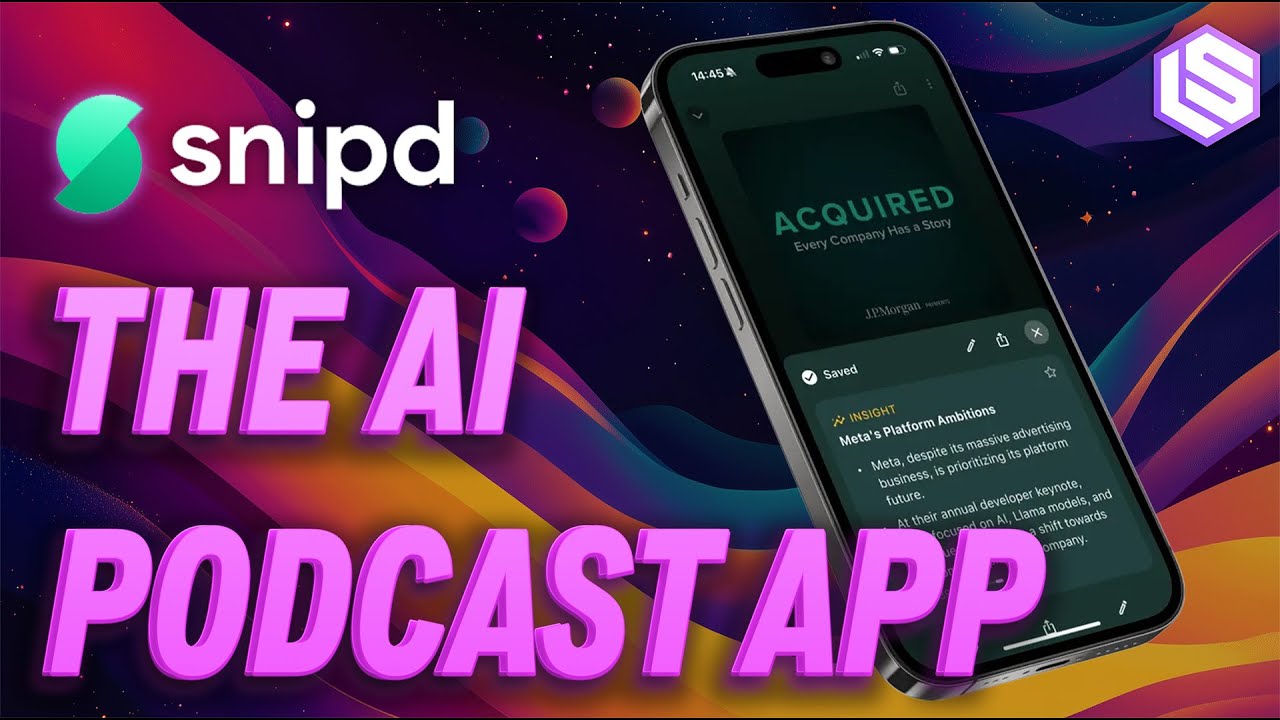
Snipd: The AI Podcast App for Learning — with CEO Kevin Ben-Smith
Mar 14, 2025 · 1:17:46
Snipd CEO Kevin Ben-Smith joins Swyx to explain how the AI-powered podcast app turns passive listening into active learning. Snipd transcribes and diarizes episodes, generates chapters, identifies mentioned books, and summarizes insights on demand — all with a four-person team. Kevin describes moving from self-hosted open-source models (Wave2vec, Pyannote) to a mix of Whisper, OpenAI, Google Gemini, and Perplexity APIs, balancing cost against the need for predictable batch processing vs. real-time user requests. He details technical hurdles like dynamic content resyncing (building a 'Shazam for podcasts') and using LLMs as judges to filter hallucinated book recommendations. The episode also covers Snipd's origin as a hackathon-winning podcast search tool, Swyx's own switch from Overcast, and Kevin's vision for voice-driven post-episode reflection and AI-assisted discovery as the next frontier.

How NotebookLM Was Made
Oct 25, 2024 · 1:13:57
Raiza Martin (NotebookLM lead PM) and Usama Bin Shafqat (AI engineer) explain how Google's NotebookLM built the viral 'Deep Dive' audio overview feature. They reveal the product evolved from Project Tailwind, using Gemini 1.5's long context and DeepMind speech to create a two-persona dialogue format that transforms documents into engaging podcasts. The team learned from 65,000 Discord members, leaned on best-selling author Steven Johnson for a 'tool for thought' workflow, and prioritized a single format over exposed controls to preserve unpredictability and delight. Humor and tension are not explicitly prompted but emerge from giving personas different angles. Evaulation relied on internal taste ('potatoes for chefs') before formal raters, with a Likert scale on dimensions like entertainment and groundedness. Future plans include multilingual support, API access, real-time chat, and codebase podcasting, while managing non-determinism by accepting occasional bad rolls.
Powered by PodHood