
All episodes
Page 2 of 6
285 episodes

Moonlake: Interactive, Multimodal World Models — with Chris Manning and Fan-yun Sun
Apr 2, 2026 · 1:06:48
Moonlake AI founders Chris Manning and Fan-yun Sun argue that interactive, multimodal world models require structured symbolic reasoning over pure scale, enabling indefinite multiplayer gameplay and causal consistency that video generation models like Genie and Sora cannot achieve. Their approach uses code engines and physics simulators as cognitive tools, producing reasoning traces that handle geometry, physics, and logic, while a separate diffusion model (Reverie) handles pixel fidelity. They aim to replace traditional rendering and empower creators by allowing human intent to be injected at a symbolic layer. Manning contrasts this with Yann LeCun's JEPA, emphasizing language and abstraction over pixel-level prediction. Moonlake is hiring engineers at the intersection of code generation, computer vision, and graphics.
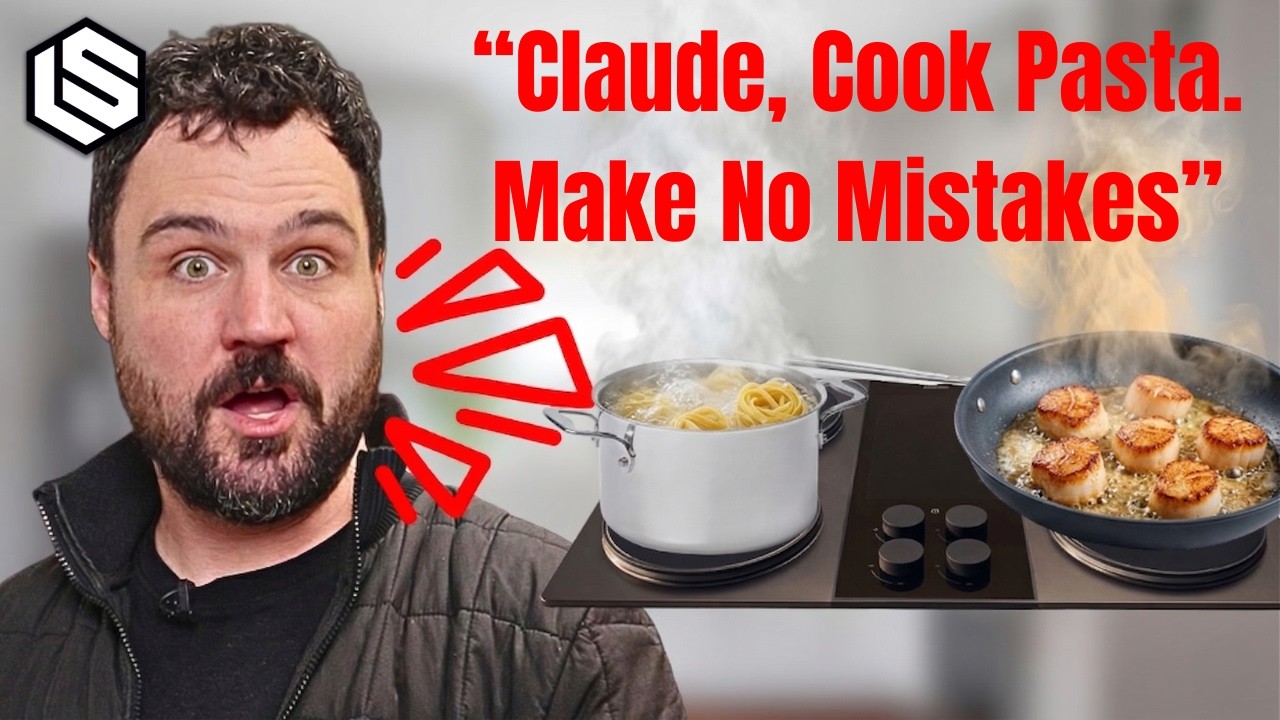
The Stove Guy: Sam D'Amico Shows New AI Cooking Features on America's Most Powerful Stove at Impulse
Mar 31, 2026 · 37:03
Sam D'Amico, founder of Impulse, demonstrates the company's induction cooktop that uses a three-kilowatt-hour LFP battery to deliver 10,000 watts—boiling a liter of cold water in 40 seconds and holding a precise temperature for searing scallops without burning. The stove is rebuilt from first principles with custom power electronics and firmware, enabling OTA updates and software-defined features; a planned update will triple temperature-control speed from one minute 50 seconds to 40 seconds. D'Amico shows AI features powered by Claude that set burner temperatures (e.g., 446°F for scallops) and fetch recipes like Korean fried chicken or egg fried rice with char siu. He explains the origin story from a pizza in Japan, the decision to enter home appliances to avoid app-store dependencies, and the Impulse Core modular platform sold to OEMs. The cooktop launches through Zephyr in hundreds of showrooms nationwide and globally this year.

Mistral: Voxtral TTS, Forge, Leanstral, & Mistral 4 — w/ Pavan Kumar Reddy & Guillaume Lample
Mar 30, 2026 · 54:02
Mistral releases Voxtral TTS, a 3B-parameter speech generation model using a novel autoregressive flow matching architecture and a 12.5 Hz neural audio codec developed in-house. Pavan Kumar Reddy and Guillaume Lample explain how the model achieves high quality and efficiency by predicting audio latents as a continuous distribution, enabling real-time voice agent applications. The episode details Mistral's stepwise multimodal strategy, starting with transcription and now speech generation, with full duplex voice agents as the next goal. Enterprise deployment via Mistral Forge allows fine-tuning on proprietary data, exemplified by training on rare languages or domain-specific jargon. Guillaume discusses merging capabilities (Mistral Small merging coding, reasoning, vision), commitment to open science through technical reports, and reasoning transfer from formal proofs in Lean. The episode also covers AI for science partnerships and hiring for research and forward-deployed engineering roles.

🔬There Is No AlphaFold for Materials — AI for Materials Discovery with Heather Kulik
Mar 24, 2026 · 35:15
Heather Kulik, MIT professor, demonstrates that AI can discover surprising new materials—such as a polymer made four times tougher via an unexpected quantum effect—but warns current models still fail basic chemistry tasks like generating a 22-atom ligand. She describes active learning with seven objectives to accelerate discovery of metal-organic frameworks for direct CO₂ capture, achieving hundred- to thousand-fold speedups per dimension. Kulik criticizes machine-learned potentials that 'look really good' but often produce nonsensical results, and notes that no large-scale experimental benchmark like CASP exists for materials. She calls for shared high-throughput cloud labs and standardized data reporting so published results are machine-learning-ready from day one. Her group's open-source tool MolSimplify (and MOFSimplify) generates transition-metal complexes and screens MOFs, and she invites feedback from users.
Dreamer: the Agent OS for Everyone — David Singleton
Mar 20, 2026 · 1:04:23
David Singleton, former Stripe CTO, introduces Dreamer, a consumer platform for discovering, building, and using AI agents and agentic apps centered on a personal Sidekick that acts as both companion and kernel-like traffic cop. He demonstrates building a conference schedule app in 25 minutes via natural language, a ski trip app that splits expenses, and tools like Gmail, Google Search, and live sports data feeds. Dreamer features an open tool ecosystem where builders get paid, a private waitlist skip at dreamer.com/latentspace, and a Builder-in-Residence program with a $10,000 prize for the best tool by mid-April. Singleton explains the OS model with Sidekick as kernel and agents as users enforcing data isolation and cross-agent coordination only through Sidekick. He shares insights on tiny-team building (six-person core, 17 total), hiring engineers who collaborate with coding agents, and LLMs' current lack of taste and creativity.

Anthropic’s Felix Rieseberg on AI Coworkers, Local-First Agents, and the Future of Knowledge Work
Mar 17, 2026 · 1:27:34
Anthropic's Felix Rieseberg explains how Claude Cowork—a VM-based, user-friendly version of Claude Code—was built from pre-existing prototypes in ten days, and why putting AI 'where you work' on the local machine is more powerful than cloud-only approaches. He argues that Silicon Valley undervalues the local computer, comparing it to how we all use MacBooks instead of iPads. The VM gives Claude its own computer, enabling it to install tools and run scripts without constant approval, serving as both a safety boundary and a capability unlock. Rieseberg contrasts Cowork's evaluation on knowledge work tasks (e.g., mortgage management, tax filing) with Claude Code's coding evals, and explains the shift from MCPs to file-based skills—markdown files that tell the model what to do. Real use cases include organizing desktops, uploading videos, and filing taxes. He also expresses concern about the impact on junior employees and hints at future work on autonomy, multiplayer coordination, and portability.

⚡️Monty: the ultrafast Python interpreter by Agents for Agents — Samuel Colvin, Pydantic
Mar 14, 2026 · 34:02
Samuel Colvin joins Shawn Wang to introduce Monty, Pydantic's ultrafast Python interpreter built with AI for agents, positioning it as a lightweight, secure alternative to sandboxes for code execution. Monty runs inside the same process, achieving sub-microsecond latency (800 nanoseconds in a hot loop), versus over a second for cloud sandboxes. Colvin explains the inspiration came from conversations at Anthropic about type safety's critical role in AI tool calling, and how Monty fills the gap between simple tool calling and full sandboxes. Monty is not full CPython—it lacks third-party library support and some standard library modules—but covers essential built-ins, implemented largely by LLMs that Colvin calls 100x faster for tasks where internal and external APIs are well-known, unit tests are trivial, and there's no API bikeshedding. He demonstrates a Pydantic AI agent using Monty to scrape LLM pricing from websites, with type checking built into the runtime so only permitted host functions (e.g., Playwright, Beautiful Soup wrappers) can be called. Colvin also shares his workflow using Claude Code, Codex, and Gemini CLI in combination for code review and implementation, and…

Retrieval After RAG: Hybrid Search, Agents, and Database Design — Simon Eskildsen of Turbopuffer
Mar 12, 2026 · 1:00:32
Simon Eskildsen, founder of Turbopuffer, explains how his obsession with the cost of vector search at Readwise led him to build a search engine on object storage and NVMe SSDs, cutting costs by 95% for customers like Cursor. He outlines the three conditions for a major database company—a new workload (AI-driven search), a new architecture (object storage first, no consensus layer), and evolving to support every query plan. Turbopuffer's architecture uses S3's strong consistency and compare-and-swap for metadata, avoiding stateful systems. Eskildsen shares how they won Notion by absorbing latency issues with dark fiber, and discusses the shift from single RAG queries to agents making many concurrent searches. He also describes the "P99 engineer"—obsessive, trade-off minded, able to bend software to first principles. Future plans include expanding full-text search, reaching Common Crawl scale, and eventually adding simpler OLAP queries.

⚡️ OpenClaw's Memory Sucks and the fix is simple — Dhravya Shah, Supermemory
Mar 9, 2026 · 27:10
Supermemory founder Dhravya Shah argues that current memory approaches like OpenClaw's static markdown files fail because they lack freshness and agent-driven retrieval, proposing a hooks-based system that dynamically injects less than 2,000 tokens per turn. His company Supermemory uses a hybrid mode combining structured memory with RAG fallbacks, achieving costs as low as 2 cents per million tokens. Shah critiques benchmarks like LongMemEval and LoCoMo for not testing personalization or forgetfulness, and his team built the open platform MemoryBench for evaluation. Future plans include plugins for Cursor and partnerships with voice agent companies, aiming for prosumer interoperability across AI providers.

Agent Inference at the "Speed of Light" — How NVIDIA moves like a $4.3 Trillion Startup
Mar 8, 2026 · 1:26:00
NVIDIA's Nader Khalil and Kyle Kranen join Swyx and Vibhu to explain how the company moves like a $4.3 trillion startup through speed-of-light (SOL) first-principles thinking, agent security boundaries, and the Dynamo inference engine. They argue agents should only do two of three things (files, internet, code) to prevent vulnerabilities, and detail Brev's acquisition to improve developer UX with one-click GPU access and DGX Spark integration. Kyle describes Dynamo as a data center scale inference engine that optimizes serving by scaling out, using prefill/decode disaggregation, Kubernetes-based scheduling, and model-hardware co-design to improve cost, latency, and quality. The episode covers SOL's role in creating urgency, long-context limits and potential 'unhobblers' like multi-head latent attention, and the shift toward CLI-first agent workflows for enterprise tools.

Why Your AI Agents Don’t Work with Dex Horthy of HumanLayer | In-Context Cooking
Mar 6, 2026 · 24:59
Dex Horthy, founder of HumanLayer and creator of "context engineering," joins Alan to recreate Dan Dan noodles while explaining why most AI agent demos fail in production and how the top 1% of AI engineers build differently from the rest. Horthy describes how his NASA JPL internship at 17 taught him pathfinding with Dijkstra's algorithm, and later coining "context engineering" after observing that public hype around open-source frameworks doesn't match enterprise reliability needs. He defines AI "slop" as low-effort derivative content often produced without reading, and introduces the "dumb zone"—a rule of thumb to start thinking about context compaction at 40% usage unless you have strong intuition. Horthy argues that while smarter models narrow the gap, the frontier of reliably achievable tasks keeps shifting, so context engineering remains valuable. He predicts software engineering will evolve from writing code to producing working code, emphasizing shipping over coding, and notes HumanLayer helps enterprises standardize AI adoption with guardrails rather than vibe coding.
Cursor's Third Era: Cloud Agents — ft. Sam Whitmore, Jonas Nelle, Cursor
Mar 6, 2026 · 1:11:18
Cursor's Sam Whitmore and Jonas Nelle detail their Cloud Agents launch, where agents get full cloud VMs to onboard repos, run code, and test changes end-to-end before returning PRs with demo videos and remote desktop access. The model decides whether to test (with /no-test to skip and /repro for bug reproduction videos). Videos cut review time by letting humans watch 20-second clips instead of giant diffs. Cursor supports parallel model swarms via best-of-N—running multiple models head-to-head on the same prompt—and subagents for context management, plus a long-running 'grind mode' for multi-day tasks. They predict cloud agents will surpass local agents in volume by year-end, driving per-developer spend to thousands per month and creating new bottlenecks in CI/CD and production pipelines.
Why Every Agent Needs a Box — Aaron Levie, Box
Mar 5, 2026 · 1:16:58
Aaron Levie, CEO of Box, argues that every AI agent needs a dedicated data repository—a 'box'—to effectively access enterprise content, and that deploying autonomous agents at scale requires new infrastructure for governance, identity, and security. He contrasts the rapid adoption of coding agents, which benefit from full codebase access and technical users, with the slower enterprise rollout where access controls, messy data, and context engineering pose major hurdles. Levie details Box's internal evals showing 15-point jumps in model performance and emphasizes the need for agents to judge when to stop searching. He discusses moving from read-only to read-write agent workflows, the challenge of keeping documentation current, and his hands-on founder approach to steering a 3,000-person public company through the AI transformation.
⚡️ Polsia: Solo Founder Tiny Team from 0 to 1m ARR in 1 month & the future of Self-Running Companies
Mar 1, 2026 · 41:56
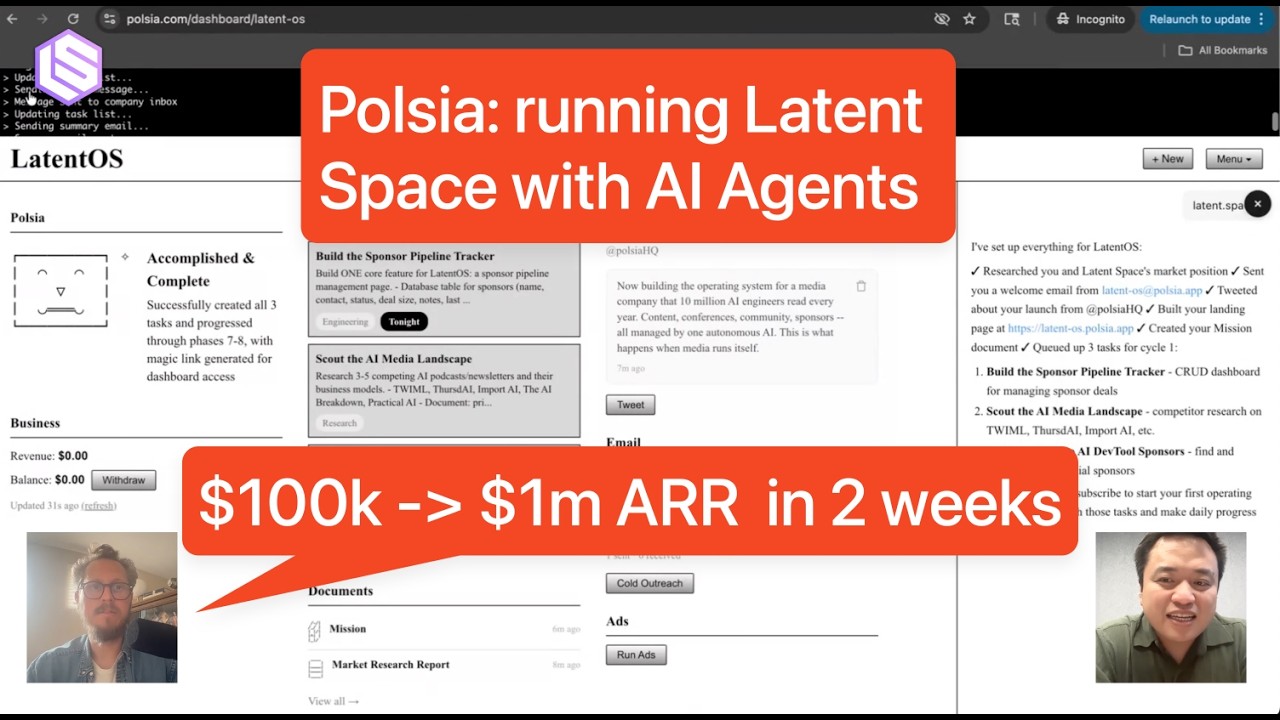
Polsia, an AI that autonomously builds and runs companies, crossed $1M ARR in its first month, solo founder Ben Cera explains on Latent Space. The platform lets users give an idea and it handles product coding, marketing, cold outreach, Meta ads, and competitive research, sending daily emails summarizing progress. Cera built Polsia for himself starting in November, stripping features to keep onboarding simple—provisioning everything so users only need to reply to an email. He uses AI agents to run Polsia itself, from fixing bugs to responding to investor inbound, embodying the vision of a self-running company. The business model charges $50/month (near break-even on model costs) and takes 20% of any revenue the user's company generates. Cera emphasizes that the hardest part was deciding what not to build, and he sees Polsia as an Apple-like ecosystem for autonomous business operations.
Measuring Exponential Trends Rising (in AI) — Joel Becker, METR
Feb 27, 2026 · 1:05:12
Joel Becker of METR explains the organization's model evaluation and threat research to assess whether AI could pose catastrophic risks, detailing their time horizon chart measuring task difficulty in human time at 50% reliability. He describes how tasks are selected for economic relevance and auto-gradability, and why time horizon is often misinterpreted as agent runtime. The episode covers Opus 4.5's surprising jump, challenges redoing developer productivity RCTs as workflows change, and why current models aren't yet catastrophically dangerous. Becker discusses potential capability explosions if R&D loops fully automate, links between compute growth slowdowns and slower capability progress, and his Manifold trading story driven by a charity market he could influence. He previews METR's 2026 plans for monitoring and risk assessment, and their hiring.

Dylan Patel Explains the AI War While Cooking | In-Context Cooking
Feb 26, 2026 · 55:13
Dylan Patel, CEO of SemiAnalysis, argues hyperscalers like Google, Amazon, and Meta will sacrifice all profits to build AI infrastructure, spending $180–$200 billion in capex this year alone, because the AI adoption explosion—Claude Code driving 4% of GitHub commits in one month, Anthropic adding $2.5 billion monthly revenue—makes it a Pascal's wager: spend or die. He details how Taiwan's semiconductor geopolitics create endgame scenarios, from a KMT win placating China to full invasion, with TSMC's output critical. Patel explains Nvidia's paranoid founder Jensen Huang is responding to vertical integration threats from hyperscalers by diversifying into chips like CPX and Groq, but warns moats are shallow. The real bottleneck in AI progress? Semiconductors themselves: fabs take years to build, and no one can buy enough GPUs through 2028. He also predicts a massive AI backlash from the public and financial markets, as capital consumption outpaces revenue and labor displacement accelerates.
🔬Max Welling: Materials Underlie Everything
Feb 25, 2026 · 34:14
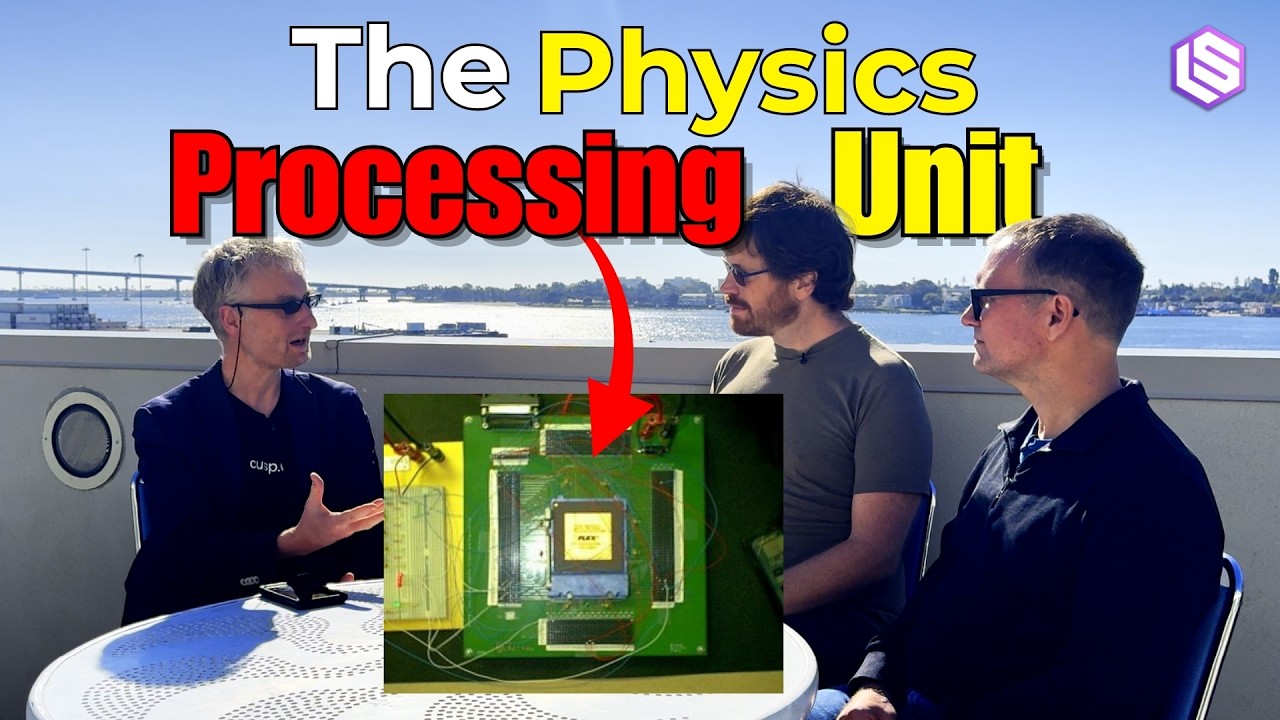
Max Welling, a pioneer in variational autoencoders and equivariant neural networks, argues that materials underlie everything from GPUs to the energy transition, and AI can turn material discovery into a search engine. He traces his career from quantum gravity with Gerard 't Hooft to climate-focused AI, founding CuspAI to accelerate carbon capture materials. CuspAI’s platform combines generative models, multi-scale digital twins, and LLM-powered agents, but Welling insists chemists remain in the loop for the foreseeable future. He explains equivariance as hardcoding symmetry into neural networks to reduce data needs, though data augmentation often works better at scale. His upcoming book reveals the identical mathematics between diffusion models and stochastic thermodynamics, promising cross-fertilization between machine learning and physics.

Claude Code for Finance + The Global Memory Shortage: Doug O'Laughlin, SemiAnalysis
Feb 24, 2026 · 2:07:40
Doug O'Laughlin, SemiAnalysis founder, explains his Claude Code awakening in December 2024: Anthropic's Opus 4.5 one-shotted tasks that used to take 24 hours, leading him to predict Claude Code will write 25–50% of all GitHub code by year-end (already 4% of commits in two weeks). He argues this marks the death of Excel and Bloomberg for analysts—'you can just do things'—but warns of a 'hygiene' crisis as junior analysts lose meta-learning. On the semiconductor side, O'Laughlin details a severe memory squeeze: HBM demand consumes 4× the DRAM capacity, DRAM prices could double again, and CXL is reviving as a workaround. He compares AI infrastructure buildout to the railroad boom (25% of U.S. gross fixed capital investment) and says Microsoft faces an innovator's dilemma—renting GPUs to 'barbarians at the gate' while its own office franchise is disrupted by Claude Code. Google's TPU v7 enjoys a temporary TCO advantage, but Nvidia's supply chain dominance (Jensen doing shots with SK and Samsung) will reassert with Rubin. O'Laughlin also reflects on his 2,800-mile Continental Divide Trail hike as essential self-mastery.
The End of SWE-Bench Verified — Mia Glaese & Olivia Watkins, OpenAI Frontier Evals
Feb 23, 2026 · 27:10
OpenAI researchers Mia Glaese and Olivia Watkins explain why they are retiring SWE-Bench Verified, arguing the benchmark is saturated and highly contaminated, with models like GPT 5.2 regurgitating ground-truth solutions or task IDs. They detail how a contamination auditor agent found evidence across Claude Opus 4.5 and Gemini Flash, and how over half of unsolved problems had unfair tests (e.g., requiring specific function names not in the spec). The team is pivoting to SWE-Bench Pro from Scale, which features harder, longer tasks (1-4+ hours), more diverse repos and languages, and far less contamination. They advocate for future coding evals to measure open-ended design decisions, code quality, maintainability, and real-world product building, while also calling for more real-world usage metrics to track AI's impact on jobs and productivity.
Inside AI’s $10B+ Capital Flywheel — Martin Casado & Sarah Wang of a16z
Feb 19, 2026 · 55:31
Martin Casado and Sarah Wang of a16z argue that AI’s capital flywheel—where model labs translate funding directly into capability gains and revenue growth in weeks—is creating a new financing playbook that blends venture and growth, with rounds acting as compute contracts. They warn that frontier labs like Anthropic can potentially raise more money than the entire app ecosystem built on their APIs, allowing them to outspend and consume those layers. The episode examines the AGI vs. product dilemma in GPU allocation, the war for talent where $10M+ packages break early-stage founder math, and Cursor as a case study of building up from the app layer while training down into its own models. They also identify “boring” enterprise software as the most underinvested opportunity and note that robotics lacks a ChatGPT moment that would justify current funding levels.
The AI Frontier: from Gemini 3 Deep Think distilling to Flash — Jeff Dean
Feb 12, 2026 · 1:23:31
Jeff Dean, Google's Chief AI Scientist, explains how the company's dual strategy of frontier "Pro" models and distilled "Flash" models, alongside co-designed TPUs and latency-optimization, keeps Gemini at the Pareto frontier. Distillation compresses high-capability large models into smaller, efficient ones, enabling Flash models to exceed earlier Pro generations. He emphasizes energy-based thinking: data movement costs thousands more picojoules than arithmetic, making batching and speculative decoding essential. TPU development requires predicting ML workloads 2–6 years out, often speculatively adding hardware features. Gemini was born after Dean wrote a one-page memo arguing that fragmented model efforts across Google Brain and DeepMind should merge into a single unified multimodal effort. Looking ahead, he predicts personalized models attending to all user data and reasoning speeds of 10,000 tokens/second will transform software engineering.
🔬Generating Molecules, Not Just Models
Feb 12, 2026 · 1:41:26
Gabriele Corso and Jeremy Wolwen, founders of Boltz, explain how their open-source models democratize biomolecular structure prediction and design, building on AlphaFold2's breakthrough in single-chain protein folding to model interactions with small molecules, RNA, and DNA. They recount how, after AlphaFold3 was kept closed by DeepMind, they built Boltz1 in months by training a single large model with mid-training bug fixes and limited compute. The conversation covers the shift from regression to generative diffusion models, the critical role of evolutionary multiple sequence alignments (MSAs), and the specialized pairwise triangular attention architecture that remains central. They detail Boltz2's addition of affinity prediction and BoltzGen's unified sequence-structure diffusion for designing proteins, nanobodies, and peptides, validated across 25 labs on targets with no known interactions. Boltz Lab provides an API and interface with optimized inference (10× faster small-molecule screening) and collaborative ranking tools, aiming to serve academia, startups, and enterprises while keeping core models open.
⚡️ Reverse Engineering OpenAI's Training Data — Pratyush Maini, Datology
Feb 10, 2026 · 27:02
Pratyush Maini from Datology reveals how the seahorse emoji question exposes that frontier models like GPT-4.1, GPT-5, and OLMo 3.1 now exhibit self-correction loops—a sign that reasoning traces are baked into mid-training data, not just post-training. By tracking response length surges four months after o1's release and corroborating with OLMo's data, Maini argues that foundation models must contain core capabilities like self-reflection, reinforcing the 'Fine Tuner's Fallacy': you cannot simply fine-tune for a capability; it must be in pre-training. He also highlights Datology's BeyondWeb project, which uses a source-rephrasing paradigm to transform internet data at trillion-token scale, achieving Nemotron-level performance in 2.7x less compute—making specialized pre-training accessible for enterprises. The episode concludes that 2026-2027 will see a shift toward domain-specific pre-training, as the cost amortizes when a smaller pre-trained model outperforms a larger fine-tuned one.
Goodfire AI’s Bet: Interpretability as the Next Frontier of Model Design — Myra Deng & Mark Bissell
Feb 5, 2026 · 1:08:41
Goodfire AI's Mark Bissell and Myra Deng argue that interpretability is the next frontier for model design, using their recent $150M Series B at $1.25B valuation to scale surgical edits of model internals beyond post-hoc poking. They explain how their platform detects behaviors like sycophancy and reward hacking, enabling targeted unlearning without wrecking capabilities. The episode covers real-world deployments from Rakuten's PII guardrails to life science partnerships with Mayo Clinic finding Alzheimer's biomarkers. Mark demonstrates real-time steering of a trillion-parameter Kimi K2 model, while Myra details how SAEs sometimes underperform probes for detection tasks. They envision a future where interpretability guides training so customization isn't brute-force guesswork.

⚡️Context Graphs: according to the authors — Jaya Gupta, Ashu Garg, Foundation Capital
Feb 4, 2026 · 33:44
Jaya Gupta and Ashu Garg of Foundation Capital introduce Context Graphs—the institutional memory of the 'why' behind business decisions, captured through decision traces of exceptions, overrides, and precedents that AI models often miss. They argue these graphs will become the defensible moat for the next generation of applied AI companies and Systems of Agents, citing early implementations at Player Zero, Olive, and Tesserae. The hosts distinguish Context Graphs from mere metadata or data meshes, emphasizing they emerge organically from automating specific workflows rather than as universal enterprise schemas. They predict that by 2026, hundreds of Context Graphs will be in production, a standard enabling stack will emerge, and the industry will shift from debating definitions to extracting value from the captured decision traces.

🔬 From Red Teaming GPT-4 to Automating Drug Discovery: The Future of AI in Science — Andrew White
Jan 28, 2026 · 1:13:56
Andrew White, co-founder of Future House and Edison Scientific, argues that automating the scientific method with LLM agents is now feasible, explaining how ChemCrow triggered White House briefings, how Kosmos uses a world model to generate and test hypotheses, and why EtherZero's reward hacking revealed the difficulty of verifiable chemistry tasks. He shifts from his academic work on molecular dynamics to building agents that enumerate and filter ideas, claiming scientific taste remains the frontier. White recounts the counterexample of D.E. Shaw Research's MD vs. AlphaFold, asserts that natural language is the universal bridge for scientific data, and predicts that automation will expand rather than eliminate scientific jobs.

⚡️ Prism: OpenAI's LaTeX "Cursor for Scientists" — Kevin Weil & Victor Powell, OpenAI for Science
Jan 27, 2026 · 36:00
Kevin Weil (VP of OpenAI for Science) and Victor Powell (Prism product lead) launch Prism, a free AI-native LaTeX editor that embeds GPT-5.2 directly into the scientific writing workflow, eliminating copy-pasting between ChatGPT and Overleaf and turning weeks of LaTeX formatting into minutes of natural language instruction. The origin story reveals Kevin discovered Victor's stealth company Cricket on Reddit and DM'd him to bring the team into OpenAI. In the live demo, Prism proofreads papers paragraph by paragraph, converts a whiteboard commutative diagram photo into TikZ code, generates 30 pages of general relativity lecture notes in seconds, and verifies complex symmetry equations in parallel chat sessions. They argue that LaTeX typesetting is the bottleneck diverting scientists from actual research, and that unlimited free collaboration and multi-line diff generation make Prism a 'tool for thought' rather than just a publishing tool. Kevin predicts 2026 will be for AI in science what 2025 was for AI in software engineering — a year when it becomes essential. The discussion also covers OpenAI's approach to accelerating science broadly, including the role of robotic labs and…

Captaining IMO Gold, Deep Think, On-Policy RL, Feeling the AGI in Singapore — Yi Tay
Jan 23, 2026 · 1:32:05
Yi Tay, who leads Google DeepMind's Reasoning and AGI team in Singapore, explains how Gemini Deep Think achieved IMO Gold by abandoning symbolic AlphaProof for an end-to-end RL-trained model. He details the on-policy RL philosophy—models learn from their own generated outputs rather than imitating others—and the critical role of self-consistency through parallel sampling and internal verification. Tay describes the IMO effort: four co-captains in different time zones, a one-week training sprint, a live competition in Australia where researchers punched in problems as they were released, and the tension of waiting for human scores to determine the gold threshold. He discusses why the team believes one model must subsume everything for AGI, the data efficiency gap compared to humans, and his hiring focus on raw talent and research taste. Tay also shares his personal fitness transformation—losing 23 kilos and improving HRV—as integral to research productivity.
Brex’s AI Hail Mary — With CTO James Reggio (acquired for $5B by Capital One!)
Jan 17, 2026 · 1:13:27
Brex CTO James Reggio details the company's three-pillar AI strategy—corporate, operational, and product AI—arguing that SOP-driven agents outperform overengineered RL in finance ops like underwriting, KYC, and fraud. He explains why Brex built an internal AI platform (LLM gateway, prompt/version management, evals) before adopting Mastra for TypeScript-based multi-agent networks, where an EA-style orchestrator coordinates specialist agents via multi-turn conversations rather than single tool calls. The audit agent pattern separates detection, judgment, and follow-up to reduce false negatives. Brex also lets employees build their own AI stack (ChatGPT, Claude, Gemini) and runs agentic coding interviews internally, with the company growing 5X and cutting burn 99% in 18 months without adding engineers.

Artificial Analysis: The Independent LLM Analysis House — with George Cameron and Micah Hill-Smith
Jan 9, 2026 · 1:18:15
Artificial Analysis founders George Cameron and Micah Hill-Smith explain how their independent benchmarking platform became the gold standard by running their own evals with a mystery shopper policy to prevent labs from manipulating results. They launched in January 2024 after building it as a side project in Sydney, going viral after Swyx's retweet. The Intelligence Index V3 synthesizes 10 datasets with 95% confidence intervals, while the Omniscience Index measures hallucination rates from -100 to +100 (Claude models lead). Their GDP Val AA benchmark tests 44 white-collar tasks, and they open-sourced their agentic harness Stirrup. They also introduced an Openness Index scoring models out of 18 points. The episode covers how they make money through enterprise benchmarking subscriptions and custom work, and why the cost of GPT-4-level intelligence has dropped over 100× while total inference spend rises due to reasoning and agentic workflows.

[State of Research Funding] Beyond NSF, Slingshots, Open Frontiers — Andy Konwinski, Laude Institute
Dec 31, 2025 · 22:34
Andy Konwinski, co-founder of Databricks and Perplexity, launches Laude Institute—a dual venture fund and nonprofit to accelerate the path from open research to breakout companies. At NeurIPS, he explains how Laude's Slingshot program funds projects like DSPy, Terminal Bench, and LMArena, and why the NSF's $1B/year for CS is insufficient, needing $10-100B for frontier AI. He argues Chinese labs (Moonshot, DeepSeek) now outpublish US because OpenAI and others stopped sharing; Open Frontiers, a live-streamed conference in SF, aims to unite top open researchers (Yann LeCun, François Chollet, Jan Leike) to reclaim global leadership. The episode also spotlights the emerging 'post-post-training' layer—prompt optimization, context management, RAG—and why research teams with multiple co-founders (like Databricks' eight) are the new gold standard for AI startups.
[State of Code Evals] After SWE-bench, Code Clash & SOTA Coding Benchmarks recap — John Yang
Dec 31, 2025 · 17:45
John Yang, creator of SWE-bench, explains the benchmark's evolution from an ignored project to the industry standard after Cognition's Devin launch, and introduces CodeClash as a new paradigm for evaluating long-horizon coding agents via programming tournaments. Yang covers SWE-bench's expansion into nine languages (JavaScript, Rust, Java, C, Ruby) and multimodal tasks, the proliferation of independent variants like SWE-bench Pro and SWE-bench Live, and the shift from unit tests to iterative agent competitions. He addresses the Tau-bench controversy over impossible tasks, arguing they serve as cheat detection, and weighs the tension between long autonomy (5-hour runs) and interactivity (Cognition's fast back-and-forth). Yang highlights the academic data problem—companies like Cognition have rich user interaction data, while academics need user simulators or compelling products like LMArena—and positions CodeClash as a testbed for studying human-AI collaboration by freezing model capability and varying interaction setups.

[State of MechInterp] SAEs in Production, Circuit Tracing, AI4Science, "Pragmatic" Interp — Goodfire
Dec 31, 2025 · 21:48
Goodfire's Jack Merullo and Mark Bissell discuss the state of mechanistic interpretability at NeurIPS, arguing interpretability is now a practical tool for deployment in high-stakes industries like healthcare and finance. They introduce paint.goodfire.ai, which lets users paint directly into Stable Diffusion's internal concept map via unsupervised feature discovery. At Rakuten, Goodfire's interpretability-based PII detection proved 500x cheaper than GPT-5 as a judge with higher recall. Merullo presents a memorization vs. reasoning spectrum, showing factual recall sits between rote memorization and logical reasoning. They highlight cross-layer transcoders and circuit tracing for scaling interpretability across all layers. Neil Nanda's pivot to 'pragmatic interpretability' is seen as validation, not retreat, and Goodfire's Pasteur's Quadrant philosophy balances foundational research with applied use cases like novel biomarker discovery in genomics.

[State of AI Papers 2025] Fixing Research with Social Signals, OCR & Implementation — Team AlphaXiv
Dec 31, 2025 · 34:45
AlphaXiv founders Raj and Rayhahn describe building the go-to platform for navigating AI research by obsessing over UI and getting authors like the Laura team to comment directly on papers, then evolving from comments to feeds to benchmarks to AI assistants. They detail how they beat Hugging Face Papers by enabling direct paragraph-level commenting and early traction with high-signal authors, and how they use social signals (views, comments, Twitter) to filter the archive firehose. They discuss the broken academic review process—20% AI-generated reviews at ICLR, quality collapsing under exponential submission growth—and argue papers are becoming less important than implementations, Docker containers, and real-world usability. Their vision: making it trivial to spin up any trending paper's code directly in browser, focusing on the top 0.1% of implementable papers that applied researchers actually care about.

[NeurIPS Best Paper] 1000 Layer Networks for Self-Supervised RL — Kevin Wang et al, Princeton
Dec 31, 2025 · 28:19
Kevin Wang, Ishaan Javali, Michał Bortkiewicz, and Benjamin Eysenbach won the NeurIPS 2025 Best Paper award for RL1000, defying conventional wisdom by scaling reinforcement learning networks to 1,000 layers deep. They show that self-supervised RL—learning representations of states, actions, and future states via contrastive classification—scales where value-based methods collapse, and that critical architectural tricks (residual connections, layer norm, classification instead of regression) unlock performance that multiplies beyond a critical depth. Scaling depth is more parameter-efficient (linear growth) than width (quadratic growth), and Jax GPU-accelerated environments enable collecting hundreds of millions of transitions in hours, providing the data abundance that makes scaling possible. The paper argues that RL is finally ready to scale like language and vision, not by throwing compute at value functions, but by borrowing self-supervised objectives, with implications for robotics via goal-conditioned RL without human supervision or demonstrations, and deployment via deep teacher, shallow student distillation.

[State of Context Engineering] Agentic RAG, Context Rot, MCP, Subagents — Nina Lopatina, Contextual
Dec 31, 2025 · 26:48
Nina Lopatina of Contextual AI discusses the state of context engineering, arguing that while the field is still in prototyping, 2025 will see true scale with full-system design patterns. She notes that agentic RAG—especially query reformulation into subqueries—has become the baseline, dramatically improving retrieval. Context rot is widely cited but industry benchmarks at real scale (100k+ documents, billions of tokens) remain rare. MCP is both a driver and a flaw: giant JSON tool definitions stuff the context window, yet MCP servers enable rapid prototyping before optimizing down to direct API calls. Sub-agents with turn limits are critical—unlimited agency degrades performance and causes hallucinations. Instruction-following re-rankers are essential for scaling retrieval across massive databases, providing more recall upfront and precision in the final context. Benchmarks are being saturated faster than ever: a Princeton benchmark from October was saturated by Claude Code in weeks, with solutions so good the gold dataset had errors. Lopatina also shares a lesson from using ChatGPT as a snowboarding coach—after several months of training for a 25-lap mogul race, she had to close…

[State of Evals] LMArena's $1.7B Vision — Anastasios Angelopoulos, LMArena
Dec 31, 2025 · 24:02
Anastasios Angelopoulos, founder of LMArena (now Arena), discusses the platform's $100M raise at a $1.7B valuation, its spin-out from Berkeley incubation by a16z's Anjney Midha, and its mission to be the industry's north star for real-world AI evaluation. He defends against the 'leaderboard illusion' paper, citing factual errors and reaffirming that models cannot pay to be on or off the public leaderboard. Arena funds inference costs for millions of monthly users, with 25% of its 5M+ users in software, and is expanding into occupational verticals (medicine, legal, creative) and multimodal video arenas. Key challenges include consumer retention, which improved with sign-in and persistent history, and moving off Gradio to React for better development. Angelopoulos calls for top talent in ML, product, and go-to-market to join the high-performance team.

[State of Post-Training] From GPT-4.1 to 5.1: RLVR, Agent & Token Efficiency — Josh McGrath, OpenAI
Dec 31, 2025 · 27:34
Josh McGrath, an OpenAI post-training researcher, states that real post-training innovation lies in data quality and signal trust, not optimization methods, with RLVR and token efficiency central. He moved from pre-training (3% compute gains) to post-training (40% behavior change), describes the infrastructure chaos of RL runs, and cites GRPO from DeepSeek Math as underappreciated for providing verifiable reward signals. GPT-5 to GPT-5.1 bumped evals while slashing tokens, emphasizing token efficiency over wall-clock time. The shopping model features interruptibility and chain-of-thought transparency, and personality toggles (Anton vs Clippy) are a key differentiator. For long context, he argues agents with graph walks may be more important than 10M-token windows. He concludes that the education system fails to produce people skilled in both distributed systems and ML research, a critical combination as bottlenecks shift.
[State of RL/Reasoning] IMO/IOI Gold, OpenAI o3/GPT-5, and Cursor Composer — Ashvin Nair, Cursor
Dec 30, 2025 · 45:13
Ashvin Nair, now ML lead at Cursor, traces his path from Berkeley robotics and an OpenAI Dota-era internship to OpenAI's reasoning team (which grew from a dozen to 300+ people) and explains why IOI Gold in 2022 felt like solving AI but didn't change the world—because RL doesn't generalize beyond training distribution. He argues most RL research from 2017-2022 overfit to benchmarks, rewarding complex ideas over simple ones that scale. At Cursor, he sees a unique opportunity for continual learning with policy updates every two hours and product-model co-design, keeping engineers in the loop instead of context-switching. His bet is that the next paradigm shift is continual learning with infinite memory: models experience something once and never forget it, storing millions of deployment tokens in weights without overloading capacity.

[State of AI Startups] Memory/Learning, RL Envs & DBT-Fivetran — Sarah Catanzaro, Amplify
Dec 30, 2025 · 28:43
Sarah Catanzaro of Amplify Partners argues that the DBT-Fivetran merger was not the death of the modern data stack but a path to IPO targeting $600M+ combined revenue, that data catalogs failed because they were built for humans rather than machines, and that RL environments are a fad. She notes that frontier labs use dbt and Fivetran for training data curation and agent analytics, and criticizes $100M+ seed rounds raised without near-term roadmaps. For 2026, she identifies personalization via memory and continual learning as the key retention unlock, observing that AI founders are unfamiliar with growth concepts like k-factor. She prefers real-world logs over synthetic RL environments, citing Cursor's use of user activity, and says the most exciting startups combine hard research problems (RAG, rule-following, continual learning) with applications that were previously impossible.

One Year of MCP — with David Soria Parria and AAIF leads from OpenAI, Goose, Linux Foundation
Dec 28, 2025 · 1:39:19
David Soria Parra, MCP lead at Anthropic, along with Jim Zemlin (Linux Foundation CEO), Nick Cooper (OpenAI), and Brad Howes (Block/Goose), recount the one-year evolution of the Model Context Protocol from a local experiment to the de facto standard for agentic systems, now donated to the new Agentic AI Foundation. They detail four spec releases—from local stdio to remote HTTP streaming, OAuth 2.1 authentication (and enterprise lessons learned), long-running tasks, and MCP Apps (iframes for richer UI)—and explain why internal enterprise adoption is exploding faster than expected, mostly invisible and at massive scale. The group reveals how three competitive AI labs came together to donate protocols and agents to a neutral foundation, how the foundation will balance taste-making (curating meaningful projects) with openness, and their 2025 vision: MCP as the communication layer for asynchronous, long-running agents that discover and install their own tools, unlocking another order of magnitude in AI productivity.

Steve Yegge's Vibe Coding Manifesto: Why Claude Code Isn't It & What Comes After the IDE
Dec 26, 2025 · 37:25
Steve Yegge argues that vibe coding—using multi-agent AI workflows—will replace traditional IDEs by January 1, calling anyone still using an IDE a 'bad engineer.' He claims Claude Code, Cursor, and the 2024 stack are already obsolete, predicting agent orchestration dashboards (like his VC project) will manage fleets of agents. Yegge highlights that senior engineers with 12–15 years of experience are the most resistant, but their productivity will be eclipsed by vibe coders. He warns that merging code becomes a new wall as agents produce 10x more code, citing one company's solution of one engineer per repo. Yegge also notes the chaos inside AI labs (OpenAI, Anthropic, Google) as they scale, and believes open‑source models will approach frontier capability within a year.
⚡️GPT5-Codex-Max: Training Agents with Personality, Tools & Trust — Brian Fioca + Bill Chen, OpenAI
Dec 26, 2025 · 27:46
OpenAI’s Brian Fioca and Bill Chen discuss the launch of Codex Max, a long-running coding agent designed to work 24+ hours, manage its own context, and spawn sub-agents. They reveal how GPT-5 training prioritized personality traits—communication, planning, and self-checking—to build developer trust, and how Codex develops tool habits like preferring 'rg' over 'grep'. The abstraction layer is shifting from models to full-stack agents, enabling partners to plug Codex into tools like VS Code or Zed. They highlight applied evals that measure real-world impact over academic benchmarks, and the need for multi-turn eval APIs. Their 2026 vision: coding agents trusted enough to handle the hardest refactors at any company, not just top-tier firms, and general enough to automate personal workflows like organizing desktops or email.
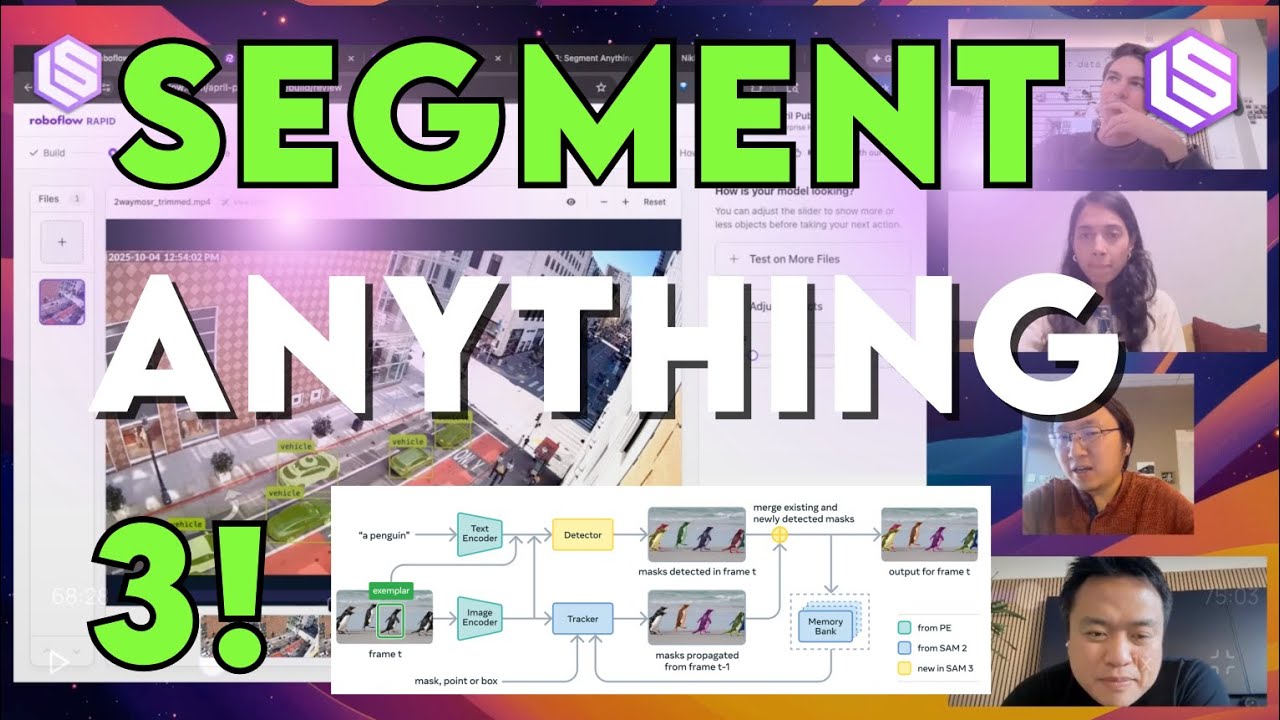
SAM 3: The Eyes for AI — Nikhila & Pengchuan (Meta Superintelligence), ft. Joseph Nelson (Roboflow)
Dec 18, 2025 · 1:15:04
Meta's SAM 3, introduced by Nikhila Ravi and Pengchuan Zhang alongside Roboflow CEO Joseph Nelson, unifies interactive segmentation, open-vocabulary detection, and video tracking into a single model that runs in 30ms on images and scales to real-time video on multi-GPU setups. The model uses concept prompts like "yellow school bus" to detect and segment every instance, separating recognition from localization via a presence token. Its data engine automated exhaustive annotation from two minutes per image down to 25 seconds using AI verifiers fine-tuned on Llama, while the new SACO benchmark contains over 200,000 unique concepts versus previous 1.2k. For video, decoupling the detector and tracker preserves object identity, and SAM 3 agents pair with multimodal LLMs like Gemini to handle complex visual reasoning. The real-world impact includes 106 million smart polygons created on Roboflow, saving an estimated 130+ years of labeling time across fields from cancer research to underwater trash cleanup.
⚡️Jailbreaking AGI: Pliny the Liberator & John V on Red Teaming, BT6, and the Future of AI Security
Dec 16, 2025 · 40:41
Pliny the Liberator and John V, leaders of BT6, argue that jailbreaking AI models exposes the futility of guardrail-based safety and that real security lies in system layers and open-source data. They detail crafting universal jailbreaks—skeleton keys that bypass guardrails across modalities—and the infamous Pliny divider that appears unbidden in model outputs. Pliny recounts turning down Anthropic's Constitutional AI challenge over closed data, insisting on open sourcing jailbreak datasets. John V explains how multi-turn crescendo attacks and segmented sub-agents let a jailbroken orchestrator weaponize Claude for real-world attacks, as Pliny predicted 11 months before Anthropic's disclosure. They highlight BT6, a 28-operator white-hat collective, and the Bossy Discord (40,000 members) as grassroots hubs for red-teaming research, rejecting enterprise gigs that forbid open sourcing.

AI to AE's: Grit, Glean, and Kleiner Perkins' next Enterprise AI hit — Joubin Mirzadegan, Roadrunner
Dec 12, 2025 · 1:09:44
Joubin Mirzadegan, a Kleiner Perkins partner who incubated Glean and now leads its next bet, Roadrunner, argues that AI-native CPQ can fix the broken quoting workflows that plague enterprise sales. Starting the CRO-only podcast Grit as a hiring wedge, he built relationships that later helped Glean and Windsurf scale. He explains why technical founders need sales leaders with a chip on their shoulder, not just fancy logos, and why Windsurf succeeded by marrying Google-class product with Salesforce-class distribution, hitting $100M ARR in months. Roadrunner rebuilds CPQ's data model from scratch, co-develops with four hairiest design partners, and aims to use LLMs to recommend deal structures, automating the Slack-channel chaos of deal desk.

The Future of Email: Superhuman CTO on Your Inbox As the Real AI Agent (Not ChatGPT) — Loïc Houssier
Dec 11, 2025 · 1:11:02
Loïc Houssier, CTO of Superhuman Mail (recently acquired by Grammarly), joins hosts Alessio and Swyx to detail how Superhuman builds AI into email without adding latency. He explains their agentic framework of small tools vs. a single agent, the fight against “agent laziness,” and their eval process anchored by Rahul’s infamous “what wood was my table?” test. Houssier reveals Superhuman uses local-first caching and Baseten’s box pricing for cost control, stores embeddings in TurboPuffer, and has only three engineers on AI—yet PR throughput rose from four to six per engineer per week. He argues the inbox will power your future AI executive assistant, and that AI will widen the gap between engineers with real fundamentals and those faking it.

The Great Evals Debate — Ankur Goyal & Malte Ubl
Dec 7, 2025 · 34:33
Ankur Goyal (Braintrust) and Malte Ubl (Vercel) debate whether offline evals are essential infrastructure or premature optimization for AI coding agents, arguing that the best teams deliberately invest in multiple feedback loops—offline evals, A/B tests, and vibe checks—to build effective AI products. They explain that modern evals are not about manufacturing golden datasets but pulling real user failures from production logs into eval suites to iterate faster. The conversation highlights how evals provide a 'first derivative' that enables aggressive shipping without regression fears, akin to unit tests in traditional software. Coding evals are uniquely verifiable (e.g., 'does it compile?') yet underutilized; Vercel uses them in RL pipelines to fine-tune models that fix trivial errors 100x faster than agentic loops. They also discuss how product managers encode domain expertise through rubrics and LLM-as-judge scoring, and why proprietary evals are competitive moats while public benchmarks serve marketing. The debate concludes that RL environments are a promising frontier for computer-use agents but require specialized expertise to avoid reward hacking.

World Models & General Intuition: Khosla's largest bet since LLMs & OpenAI
Dec 6, 2025 · 1:04:51
Pim de Wit, founder of Medal and General Intuition (GI), turned down a reported $500M offer from OpenAI to spin out GI with a $134M seed from Khosla Ventures — Vinod Khosla's largest bet since OpenAI — arguing that world models trained on peak human gameplay are the next frontier after LLMs. Medal's 12M users generate 3.8B action-labeled clips via retroactive recording, creating a privacy-preserving dataset of 'episodic memory for simulation.' GI builds fully vision-based agents that see only frames and output actions in real-time, using pure imitation learning without RL, and can transfer from arcade games to realistic games to real-world video. Pim explains why world models need actions, memory, and partial observability (e.g., smoke, camera shake) compared to video generation, and how they distill giant policies into tiny real-time models that navigate and hide like humans. He recounts his path from running the largest RuneScape private server to reverse engineering, cold-emailing the Diamond (world model) paper authors to assemble a top research team, and advises data founders to train models themselves before selling. GI's near-term customers are game developers replacing…

After LLMs: Spatial Intelligence and World Models — Fei-Fei Li & Justin Johnson, World Labs
Nov 25, 2025 · 1:00:39
World Labs co-founders Fei-Fei Li and Justin Johnson argue that spatial intelligence is the next frontier beyond LLMs, with their product Marble generating editable 3D worlds from text or images using Gaussian splats. They claim language is a lossy channel for describing the rich 3D/4D world, while spatial intelligence handles everything from picking up a mug to inferring DNA's double helix. Marble already serves gaming, VFX, and film, with precise camera control and real-time rendering on phones and VR headsets. They discuss scaling compute from AlexNet to today's million-fold increase, why world models can 'soak up' modern GPU clusters better than language alone, and the gap between pattern-fitting and causal understanding in physics. Fei-Fei worries more about under-resourced academia than open vs. closed models, advocating for national AI compute clouds and open benchmarks like the BEHAVIOR dataset. Justin notes transformers are natively set models, not sequence models, opening architectural possibilities for new spatial data.
Powered by PodHood