
All episodes
Page 3 of 6
285 episodes

⚡️ Building the AI Hardware Engineer with Matthias Wagner, Co-founder of Flux
Nov 22, 2025 · 49:03
Matthias Wagner, CEO of Flux.ai, describes building the "AI hardware engineer" that turns product briefs into manufacturable PCB designs in under 30 minutes. After leaving Meta in 2019, Wagner built a browser-based collaborative CAD tool from scratch, designed as a reinforcement learning environment. The emergence of LLMs and reliable tool calling let Flux's agents search component libraries, check pricing and availability, and execute complex designs autonomously. In a live demo, Wagner designs a battery-powered Alexa-like device with ESP32, microphones, OLED display, and speaker in about 25 minutes. Flux now has 7,000 paying customers, growing 26x year over year, and Wagner envisions eventually letting users prompt full hardware products like smartphones into existence, claiming the cost of custom manufacturing is plummeting.

⚡️ 10x AI Engineers with $1m Salaries — Alex Lieberman & Arman Hezarkhani, Tenex
Nov 19, 2025 · 27:11
Tenex co-founders Alex Lieberman and Arman Hezarkhani explain how they compensate AI engineers by story points instead of hours, enabling some to earn over $1 million annually while delivering 10x productivity gains. The model emerged after Arman downsized his previous company Parthian's engineering team by 90% yet saw a 10x increase in production-ready software output by re-architecting with AI. They avoid gaming by hiring engineers who are long-term selfish or love coding, and pair them with technical strategists incentivized on account retention. Example projects include building a retail camera prototype in two weeks and a trivia app that hit #20 on the App Store in a month. Their default stack is TypeScript with React and Express, and they switch between coding agents like Claude Code and Codex based on daily performance. They identify human capital as their main constraint and context engineering or entropy reduction as the core challenge for autonomous AI engineers.
Anthropic, Glean & OpenRouter: How AI Moats Are Built with Deedy Das of Menlo Ventures
Nov 14, 2025 · 1:26:59
Deedy Das of Menlo Ventures returns to explain how Anthropic became the fastest-growing software company ever (zero to billions in revenue) and why Glean’s boring enterprise search moat of hard integrations and ranking problems is harder than competitors think. He reveals the $100M Anthology Fund’s strategy: backing OpenRouter, Goodfire, Prime Intellect, and Whisper—companies that solve thorny infrastructure or research problems rather than chasing apps. Das argues that model-layer companies will capture most value because building great models is harder than building apps, and that Anthropic’s product innovations like Claude Code emerge from a culture that lets researchers experiment freely. He also warns that vibe coding is becoming a cognitive crutch for engineers, eroding deep problem-solving skills, and discusses how enterprise AI market share has shifted dramatically: OpenAI went from 50% to 20%, while Anthropic rose from 12% to 32% of enterprise LLM API spend.

⚡ Inside GitHub’s AI Revolution: Jared Palmer Reveals Agent HQ & The Future of Coding Agents
Nov 10, 2025 · 35:52
Jared Palmer, SVP at GitHub and VP at CoreAI at Microsoft, traces his journey from building v0 at Vercel—a focused Next.js coding agent that grew from $1M ARR to millions more after adding chat—to launching Agent HQ at GitHub Universe, a collaboration hub for developers and coding agents. He explains how v0's success came from laser-focus on one stack and framework, and how GitHub's 180M developers enable scaling agent-based workflows. Palmer discusses model strategy tradeoffs (composite vs. branded models), the challenge of repo setup and infrastructure reliability, and using coding agents for non-coding tasks like automating Excel workflows. He reveals Stacked Diffs as GitHub's top feature request, with active exploration after previous attempts, and outlines his vision for seamless AI integration across GitHub, VS Code, and Actions, including features like resolving merge conflicts with AI.

⚡ Inside Google Labs: Building The Gemini Coding Agent — Jed Borovik, Jules + AIE CODE Preview
Nov 10, 2025 · 43:53
Jed Borovik, Product Lead at Google Labs, explains how Google builds Jules, an autonomous coding agent that runs on its own VM for long-running tasks, challenging the assumption that agents should operate locally. He reveals that as Gemini models improved, Jules' scaffolding simplified, shifting from sub-agent patterns and embedding-based RAG to attention-based search. Borovik discusses context window management for sessions lasting up to 30 days with 2 million tokens, and argues that coding agents will increase demand for software engineers (Jevons paradox), not eliminate jobs. He calls for better specification tools beyond chat, such as multimodal input and interactive planning, to move beyond 'vibe coding' toward verifiable, reliable agentic workflows.

⚡️ The State of AI Engineer Hiring: Cheating, AI Adoption,Junior Devs — Vivek Ravisankar, HackerRank
Nov 8, 2025 · 49:05
Vivek Ravisankar, CEO of HackerRank, reveals that while overall tech hiring has flattened year-over-year, AI-specific roles are exploding and companies are reversing their stance on junior hiring because new grads are the true AI natives who embrace tools like Devin and Cursor without hesitation. He details HackerRank's integrity challenges—from leaked questions on Chegg to AI cheating tools like Interview Coder—and their countermeasures: custom-trained plagiarism models with 85-90% precision, DMCA takedowns, and a proctor mode that can shut down unauthorized apps. Rather than fighting AI, HackerRank embeds AI assistants into assessments, shifting from LeetCode-style tasks to real-world code repository challenges. Ravisankar defines the next-gen developer by four attributes: strong software engineering fundamentals, ability to use AI across the entire SDLC, deep knowledge of AI concepts from prompt engineering to fine-tuning, and good taste with business acumen. He predicts a proliferation of developers across all business functions—with roles like 'full-stack marketers' and 'go-to-market engineers'—and notes the irony that the most AI-forward companies like Anthropic explicitly…
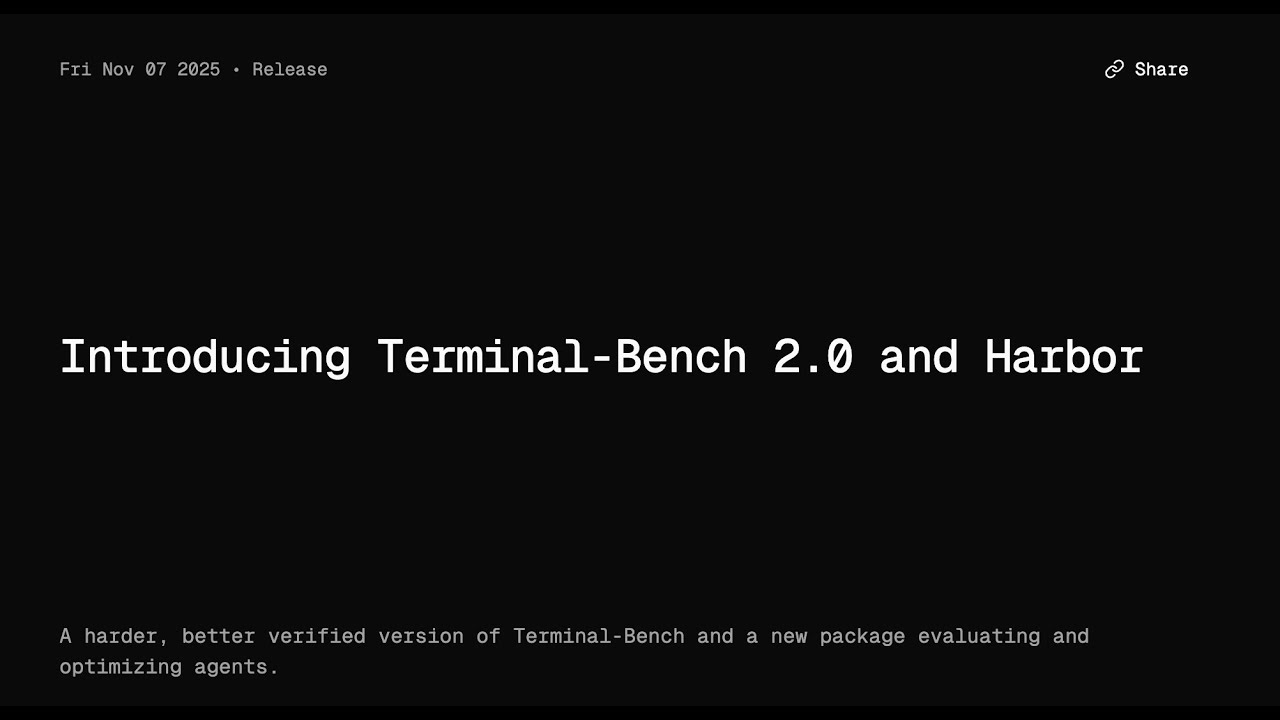
Terminal-Bench 2.0: the most impt coding agent benchmark of 2025 gets a v2! Launch + Q&A w/ founders
Nov 8, 2025 · 35:01
Terminal-Bench co-creators Mike Merrill, Alex Shaw, and collaborators Andy Konwinski, Ludwig Schmidt, and Aatash launch Terminal-Bench 2.0, an 89-task coding benchmark with rigorous human and LM-assisted verification to test agent performance on real-world tasks like designing DNA primers and installing Windows 3.11. They reflect on Terminal-Bench 1's problems—easy tasks and reproducibility—and detail spending 300 hours manually auditing each task. They introduce Harbor, an open-source package for running sandboxed agent rollouts, standardizing task format and integrating with agents like Codex and Claude Code. Aatash shows using Harbor to generate thousands of training traces for DataComp Agent, running 1,000 parallel sandboxes. Future plans include expanding to scientific computing.

Priscilla Chan and Mark Zuckerberg: Frontier AI + Virtual Biology To Solve All Diseases
Nov 6, 2025 · 53:34
Priscilla Chan and Mark Zuckerberg, co-founders of CZI's Biohub, explain their ten-year shift from broad philanthropy to a focused mission of building frontier AI and virtual biology to cure all diseases. They argue that tool-building — from 12-foot microscopes to the 125-million-cell CELLxGENE atlas — is the essential, underfunded work that enables scientific breakthroughs. The couple details how their Biohub model combines frontier biology (e.g., spatial imaging, cellular engineering) with frontier AI (models like rBio and VariantFormer) to create a hierarchical virtual cell, eventually expanding to a virtual immune system. They emphasize that data generation must precede modeling, citing the decade-long Human Cell Atlas as foundational, and note that AI timelines may accelerate their 100-year goal significantly sooner. The episode closes with a call for biologists and engineers to collaborate, use their open models, and help generate data that grounds these next-generation tools.

How Zyphra went all-in on AMD + Why Devs feel faster with AI but are slower — with Quentin Anthony
Nov 3, 2025 · 1:00:02
Quentin Anthony, head of model training at Zyphra and advisor at EleutherAI, explains why his company moved all training to AMD MI300X GPUs, outperforming Nvidia H100s on certain workloads thanks to 192GB VRAM and higher memory bandwidth, and describes his kernel development approach of writing directly in ROCm or GPU assembly rather than using Triton. He also shares his experience in the METR study on AI coding productivity, where he was one of the few developers with measurable speedup, and offers tips: timebox AI use, avoid the slot machine effect, maintain context hygiene, and use direct API over tools like Cursor. Additionally, he argues that open source AI research benefits from siloed focused teams with guaranteed funding over grand collaborations, and notes that kernel datasets alone won't solve GPU programming due to evaluation challenges.

⚡️Automating Scientific Discovery - Jessica Rumbelow, Leap Labs
Nov 2, 2025 · 27:32
Jessica Rumbelow, founder of Leap Labs, explains how their Discovery Engine automates scientific discovery by systematically extracting novel patterns from datasets using neural network interpretability, achieving 100x faster analysis than manual methods. The tool has uncovered unexpected findings: novel T-cell receptor markers for tumor reactivity, a synergistic effect between manganese and genotype on root architecture for drought-resistant crops, and a 20% violation of the foundational surface layer assumption in meteorological modeling, worth billions if improved. Rumbelow contrasts Claude 4.1 Opus alone (which hallucinated and overgeneralized) vs. Claude with Discovery Engine (which became powerful at synthesis), arguing that language models need specialized tools for unbiased, hypothesis-free discovery. The platform is domain-agnostic, free for academics publishing their data, and expanding to multimodal datasets and industry pilots.

⚡️ Ship AI recap: Agents, Workflows, and Python — w/ Vercel CTO Malte Ubl
Nov 1, 2025 · 42:02
Vercel CTO Malte Ubl discusses the company's AI strategy, centered on the new Workflow Development Kit that enables durable, resumable serverless functions with infinite idle time at no cost. He explains how the AI SDK was extracted from v0 and remains deliberately low-level to accommodate emerging patterns, with a direct agent abstraction now stable in version six. Ubl details Vercel's internal agents—including a DevOps agent that investigates production anomalies by querying observability data and logs, solving the recall-precision problem in alerting—and the 'Agent on Every Desk' program that helps large companies build their first three agents. He also covers zero-config Python support for Flask and FastAPI, and a security model that assumes developers cannot be trusted, extracting auth and data access from application code.

The Agents Economy Backbone - with Emily Glassberg Sands, Head of Data & AI at Stripe
Oct 30, 2025 · 1:37:13
Emily Glassberg Sands, Head of Data & AI at Stripe, explains how Stripe builds economic infrastructure for AI, processing 1.4% of global GDP. Stripe's domain-specific foundation model runs inline on the charge path, detecting card-testing attacks on large users with detection rates improving from 59% to 97%. The Agentic Commerce Protocol (ACP) with OpenAI creates a shared standard for businesses to expose products to AI agents, adopted by Walmart and Sam's Club. Stripe helps AI companies combat new fraud vectors like free trial and refund abuse, and launched token billing to let wrappers price based on real-time inference costs. Internally, 85% of Stripes use LLM tools daily, with code generation and merchant understanding as key use cases. Emily argues AI companies grow 2-3x faster than SaaS, are twice as global, and that agentic commerce will expand consumption by removing time constraints for high-income consumers.
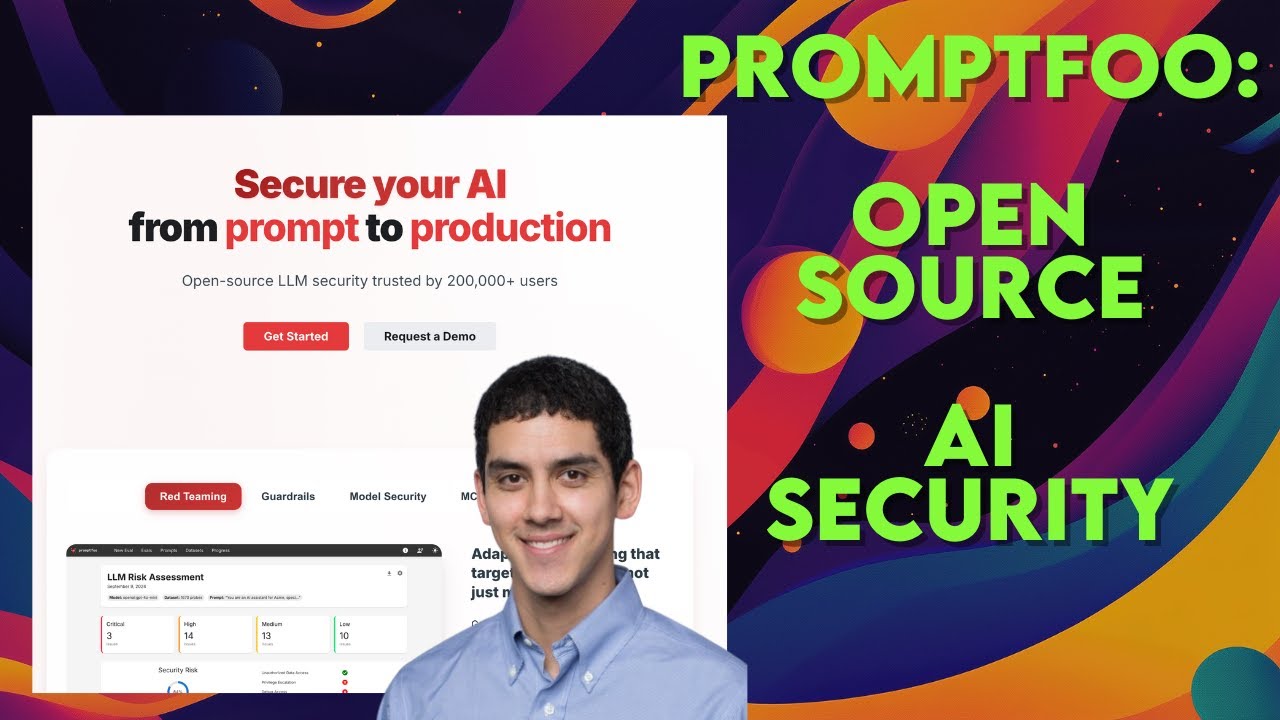
Breaking AI to Fix It: Ian Webster's Journey from Discord's Clyde to Promptfoo's $18M Series A
Oct 24, 2025 · 43:17
Ian Webster, founder of Promptfoo (recently $18M Series A from Thrive Capital and NEA), explains how his journey from building Discord's AI chatbot Clyde to creating the leading AI security testing platform revealed that while evals are table stakes, the real value lies in pre-deployment red teaming that finds application-specific risks. Webster argues that traditional guardrails are insufficient—'you can't fix stupid'—and that Promptfoo uses AI-versus-AI techniques to generate tailored attacks for each app's business context. Over 10% of Fortune 500 companies now use Promptfoo, and he discusses the evolving challenges of MCP security (mostly 'glorified API wrappers') and the need for IDE plugins and code-aware discovery to keep up with increasingly complex agents running 30-minute tasks. The episode also covers why security sales in AI is uniquely hard, how open source builds trust in a space full of 'snake oil,' and why the future of AI security must shift from runtime protection to earlier testing in CI/CD.

⚡ Open Model Pretraining Masterclass — Elie Bakouch, HuggingFace SmolLM 3, FineWeb, FinePDF
Oct 20, 2025 · 1:03:40
Elie Bakouch, Hugging Face's pre-training lead and architect behind SmolLM, presents a five-pillar framework for model training spanning data quality, architecture, information extraction, gradient quality, and stability, while breaking down recent innovations in optimizers, Mixture of Experts, and data rephrasing. He explains that the field of optimizers is moving beyond AdamW with Muon and Shampoo, noting that speed-ups are often exaggerated due to undertuned baselines. He deep-dives into MoE architecture, showing that expert specialization requires load balancing at the global batch level, as demonstrated by Qwen's findings. He discusses the rephrasing revolution, where converting low-quality web data into QA format yields non-random MMLU performance even for small models. Elie also highlights Hugging Face's open science contributions: FinePDF (new PDF dataset), FineWeb-Edu2, and tools like Nanotron, Datahub, and Liteval.

Terminal-Bench: Pushing Claude Code, OpenAI Codex, Factory Droid, et al to the limits
Oct 18, 2025 · 35:27
Alex Shaw and Mike Merrill, creators of Terminal-Bench, explain how their coding agent benchmark became an industry standard adopted by Anthropic, OpenAI, and leading agent companies. They bet on terminal-based interaction over GUI because text is the modality that works best with models, and designed tasks as containerized environments with instructions and test scripts. Nicholas Carlini at Anthropic became an early champion, leading to Terminal-Bench being featured on Claude’s model card without notice. They built the minimal Terminus agent to isolate model capabilities from agent optimizations, and their framework adapts existing benchmarks like SWE-bench. Future plans include cloud hosting, multi-dimensional evaluation incorporating cost and economic value, and enabling RL post-training on benchmark tasks.

Why RL Won — Kyle Corbitt, OpenPipe (acq. CoreWeave)
Oct 16, 2025 · 1:08:23
Kyle Corbitt, co-founder and CEO of OpenPipe (acquired by CoreWeave), explains why reinforcement learning has replaced supervised fine-tuning for training reliable AI agents. He argues GRPO is a dead end due to its requirement for perfectly reproducible parallel rollouts, which is extremely hard in practice. Instead, OpenPipe’s RULER uses relative LLM-as-judge rewards, achieving state-of-the-art performance even with a weak judge. Corbitt reports that 90% of AI projects remain stuck in proof-of-concept due to reliability issues, and that LoRAs are underrated for production while GEPA failed in his tests. He predicts continuous RL from real-world experience can unlock 10x more inference demand.

Building Jamba 3B: the tiny Hybrid Transformer State Space Reasoning Model - Barak Lenz, CTO of AI21
Oct 11, 2025 · 45:05
Barak Lenz, CTO of AI21, presents their Jamba 3B model as a tiny hybrid transformer-state space model that brings long context capabilities to edge devices, and argues enterprises need AI systems like Maestro over standalone models. Lenz explains that the 1:8 ratio of attention to Mamba layers emerged from extensive ablations, with attention placed in the middle of the block working best. The Jamba 3B model uses a 1:12 ratio to maximize efficiency, fitting the same context length as larger models with a fraction of memory. He notes that pure Mamba underperformed on some tasks but hybrid models resolved those deficiencies, and that images quickly become long context problems (4 images can be thousands of tokens). For enterprise, Lenz advocates for model-agnostic orchestration layers treating models as "actions" with statistical properties, enabling continuous learning and cost optimization without vendor lock-in. Drawing from his algo trading background, he compares training frontier models to developing trading algorithms, emphasizing the importance of world-class engineering and avoiding brute force reasoning.

DevDay 2025: Apps SDK, Agent Kit, MCP, Codex and why Prompting is More Important than Ever
Oct 7, 2025 · 44:52
Sherwin Wu and Christina Huang from OpenAI's platform team discuss the new AgentKit suite and Apps SDK, arguing that visual agent builders and prompt optimization remain critical for production AI. They detail AgentKit's components—Agent SDK, visual Builder, Evals, and Tool Registry—and how Apps SDK inverts the website-chatbot paradigm by embedding apps inside ChatGPT. OpenAI adopted Anthropic's MCP protocol for tool connectivity, and the team dogfoods these tools for their own customer support at openai.com. They explain that automated prompt optimization and evaluation pipelines are essential for scaling agents, and share how Codex is used internally for code generation and PR reviews. The episode also covers the Service Health Dashboard for real-time API SLO tracking, reflecting OpenAI's reliability investments.

⚡️Traversal: Causal ML and Reinforcement Learning
Oct 5, 2025 · 45:06
Anish and Raaz, co-founders of Traversal, explain how their agentic architecture combines causal machine learning and LLMs to turn incident troubleshooting from a massive search problem into an intelligent, context-driven process. Both have PhDs in causal ML and RL from MIT and Berkeley, and they applied that expertise to root cause analysis in complex enterprise systems with petabytes of fragmented data across logs, metrics, traces, and Slack. Their system dynamically combines statistical tests (for time-series) with semantic understanding (via LLMs) to winnow billions of signals to root cause candidates in under two minutes. They note that reasoning models like o3 are critical for complex incidents, while Claude is better for tool calling and unsticking. Traversal uses a mix of infrastructure size and investigation count for pricing, and sees self-healing as a continuum: 10–20% of issues can be autonomously resolved now, with 30–40% requiring senior engineer sanity-check within 6–12 months. They are hiring in New York and emphasize that building proprietary evals is core IP, making public benchmarks a tension.

The antidote to AI fatigue — Answer.ai Solveit
Oct 2, 2025 · 55:26
Jeremy Howard, Eric Ries, and Johno Whitaker join host Alessio to present Answer.ai's Solveit platform, arguing that human-in-the-loop, step-by-step AI collaboration outperforms fully autonomous agents for complex coding and writing tasks. The 12-person team built their own integrated development and deployment system, eschewing cloud vendors. Solveit provides each user a persistent Linux Docker container with a Jupyter-like interface where the AI can see all steps, enabling immediate error correction and iterative improvement. Johno demonstrates building a perfume scent search engine in under an hour; Eric shows how he uses Solveit to manage writing his book 'Incorruptible', incorporating test reader comments and fact-checking sections. Jeremy reveals they turned Andrej Karpathy's GPT tokenizer video into a polished blog post. The Solveit course launches October 20th at solve.it.com, teaching this philosophy beyond just the tool.

Taste is your Moat (Dylan Field of Figma)
Oct 2, 2025 · 1:01:43
Dylan Field, CEO of Figma, argues that as AI accelerates software creation, design becomes the key differentiator—and Figma Make, a prompt-to-app tool, is Figma's bet on lowering the barrier for everyone. Field recounts his first AI-pill moment with Chris Olah in 2014 and later GPT-3 convincing him of exponential progress. He explains Figma's strategy: treat natural language as today's interface (calling it the 'MS-DOS era of AI'), use Figma as a 'context repository for aesthetics' to ground AI outputs in a user's taste, and solve the blank-canvas problem by letting AI generate initial designs. Field pushes back on 'fast fashion' software, arguing complex products like Workday can't be vibe-coded. He shares Thiel Fellowship lessons (start with 'what could this be' before finding flaws), recruiting advice from John Doerr (obsess over the funnel), and caution about get-rich-quick AI hype, drawing parallels to the NFT cycle he exited.
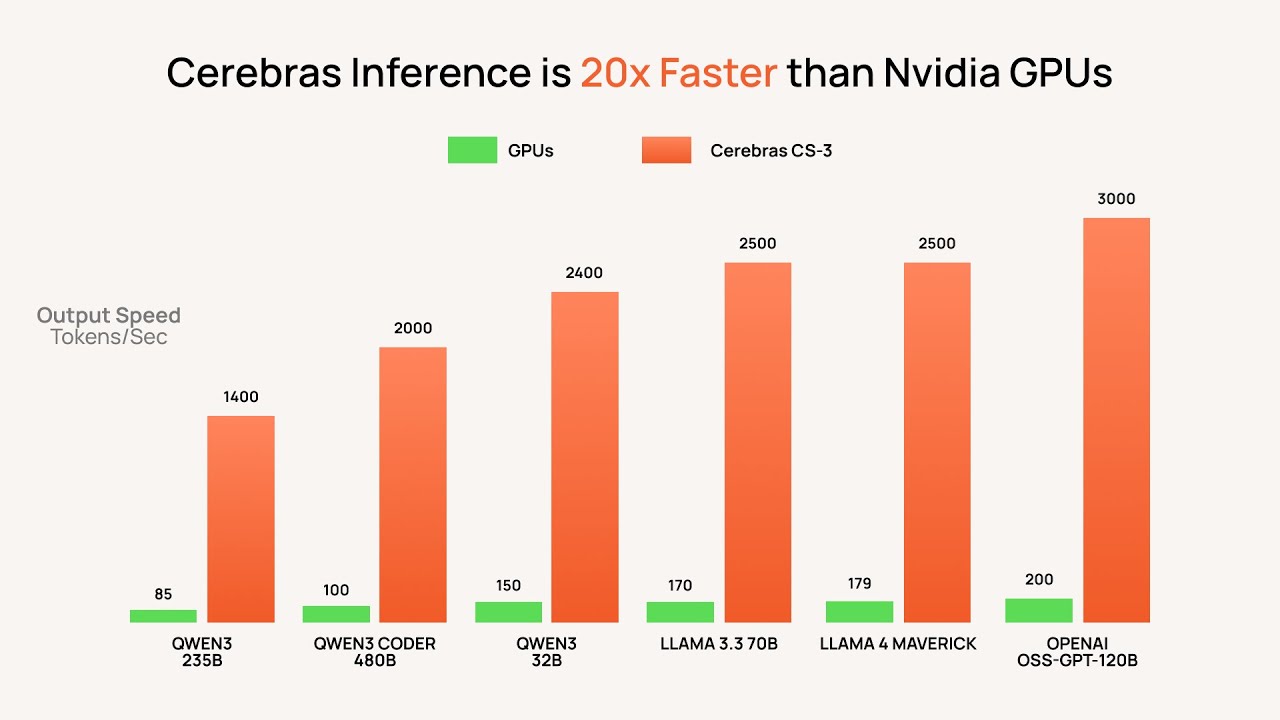
⚡️Raising $1.1b to build the fastest LLM Chips on Earth — Andrew Feldman, Cerebras
Oct 1, 2025 · 29:14
Andrew Feldman, CEO of Cerebras, joins Latent Space to discuss their $1.1B fundraise at an $8.1B valuation and their wafer-scale chip that delivers 20x faster inference than NVIDIA's B200 GPUs. He explains how their architecture uses SRAM instead of HBM, providing 2,625x more memory bandwidth by eliminating the narrow straw between compute and memory. Feldman details the decision to accelerate sparse linear algebra rather than specialized convolutions, enabling support for transformers and diffusion models unseen during design. He discusses the explosive growth in AI inference demand, the shift from closed-source to fast open-source models, and the importance of speed—citing Paul Graham's observation that ChatGPT's slowness drives users away. The conversation covers enterprise trends in the 10-30B parameter space, the complexity of building data centers that pull gigawatts of power, and the often-overlooked routing and caching systems that make AI work seamlessly.

⚡️Claude Sonnet 4.5 and Anthropic's roadmap for Agents and Developers — Mike Krieger, Anthropic
Sep 30, 2025 · 26:25
Mike Krieger, Anthropic's CPO, discusses the launch of Claude Sonnet 4.5 and its implications for AI development, emphasizing the growing symbiosis between product and research teams. He describes his personal 'vibe evals' for new models, including generating a Virtual Boy-style game and a Nintendo board presentation, and notes that Sonnet 4.5 traffic eclipsed Sonnet 4 on day one. Krieger explains how Anthropic is improving model output quality across UIs, Excel, and PowerPoint, and highlights the shift toward interactive planning rather than pure autonomy. He reveals the rename of the Claude Code SDK to the Claude Agent SDK, reflecting its general-purpose use for complex agentic workflows beyond coding. Krieger stresses the need for better visual understanding in models and invites developers to share feedback on hard challenges to help improve the platform.

Amp: The Emperor Has No Clothes
Sep 25, 2025 · 1:21:59
Quinn Slack (CEO) and Thorsten Ball (Amp Dictator) from Sourcegraph discuss Amp Code, a coding agent that ships 15x/day with no code reviews. They explain the strategic pivot from Cody to Amp, emphasizing that building the best coding agent trumps everything else. The team dogfoods Amp internally, using it to build itself, and maintains both a VS Code extension and CLI, with a 50/50 internal split. They argue that model choice is becoming less important than the harness around the model, and they reject features like prompt enhancers, custom subagents, and MCP servers as not adding value. Common failure modes include outsourcing thinking but not typing and using agents without proper context engineering. They predict async agents running 24/7 will dominate, and they target early adopters willing to adapt their codebases and workflows for maximal agent effectiveness.

⚡️Snowglobe: Simulations for your AI
Sep 25, 2025 · 26:14
Shreya Rajpal returns to Latent Space to launch Snowglobe, a simulation engine that lets developers test AI products by generating diverse simulated user interactions before production, inspired by self-driving car simulation where Waymo logged 20 billion simulated miles versus 20 million real miles. She explains how simulation uncovers failures like over-refusal—a problem that emerged for a design partner who initially worried about toxicity—by generating personas with varied styles and goals. Snowglobe uses a multi-model architecture (proprietary and open source) to create realistic, diverse conversations, and it supports testing across chat, voice, and tool-calling agents. Pricing is usage-based per message, with persona modeling included. Shreya highlights enterprise use cases, such as comparing vendors or generating training data for fine-tuning, and notes the company is hiring a product designer, product engineer, and research staff.
⚡️ Beyond Transformers with Power Retention
Sep 23, 2025 · 32:59
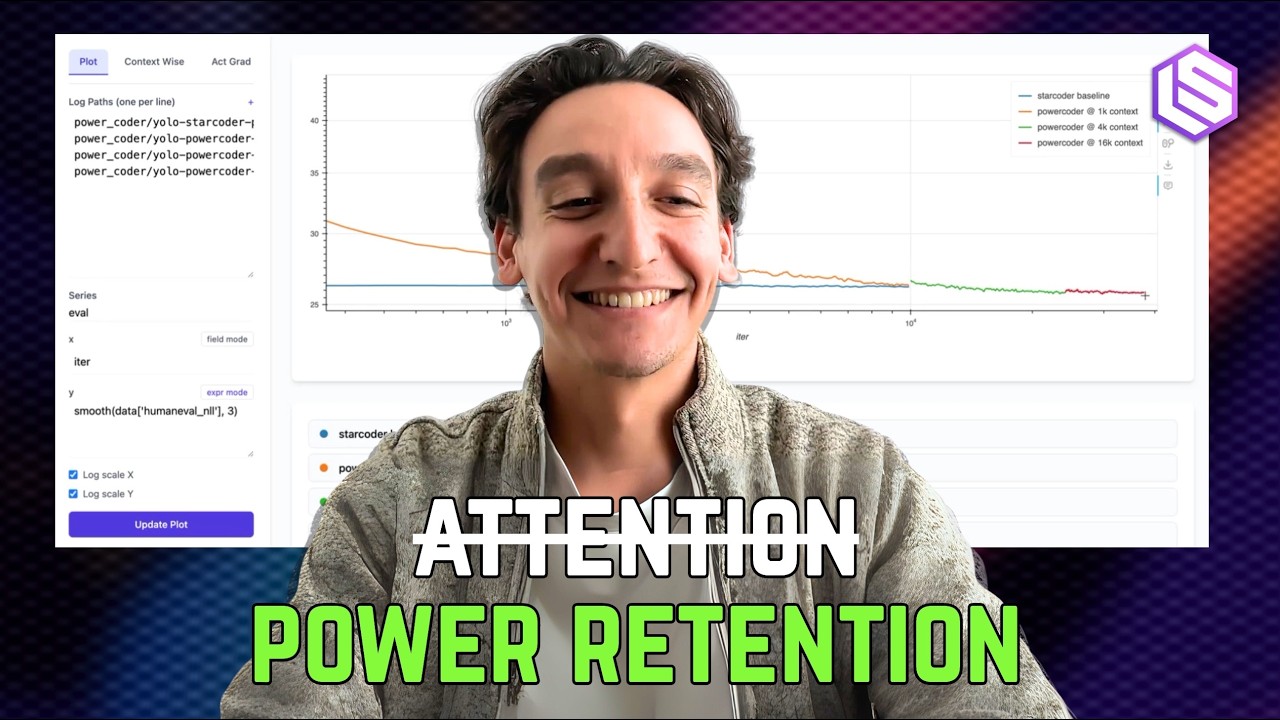
Jacob Buckman, CEO of Manifest AI, discusses their solution to AI's expensive computational bottleneck: the ever-growing KV cache for long context inference. Power Retention replaces attention in transformers with a fixed-size memory, achieving 10X training speedup at 64K tokens and 100X inference speedup over FlashAttention. Manifest releases Vidrial, a just-in-time CUDA kernel framework that finds optimal configurations, and Metamorphosis, a process to convert existing transformers like StarCoder-3B into Power Retention models in just two hours of mid-training. Buckman demonstrates PowerCoder, a 3B code model that matches baseline loss after 10K steps and handles contexts up to 32K and beyond. The open-source release includes kernels and tools, aiming to build community trust and encourage adoption by inference providers. He also highlights the need for genuinely long-context datasets beyond internet text, such as human trajectories.

⚡️No, Don't Do Palantir for AI - Brendan Falk, Hercules (AUDIO FIXED)
Sep 18, 2025 · 35:08
Brendan Falk, founder of Zeus (now Hercules), explains why he abandoned his vision to become 'Palantir for AI' after six months of enterprise AI transformations. Targeting Global 2000 companies with $5–10M contracts, he found that each use case required custom development, messy data, and high ongoing maintenance, with work scaling poorly across contract sizes. He also faced existential threats from specialized vendors like Decagon and Sierra, who could outspend and out-focus on single use cases. Falk pivoted to Hercules.app, an AI website builder that ships production apps, white-labeling payments and email. He argues the app builder market (Wix, Squarespace, Shopify) will expand with AI, and that brand and ease will sustain higher margins than developer tools like Cursor.
Context Engineering for Agents - Lance Martin, LangChain
Sep 11, 2025 · 1:03:18
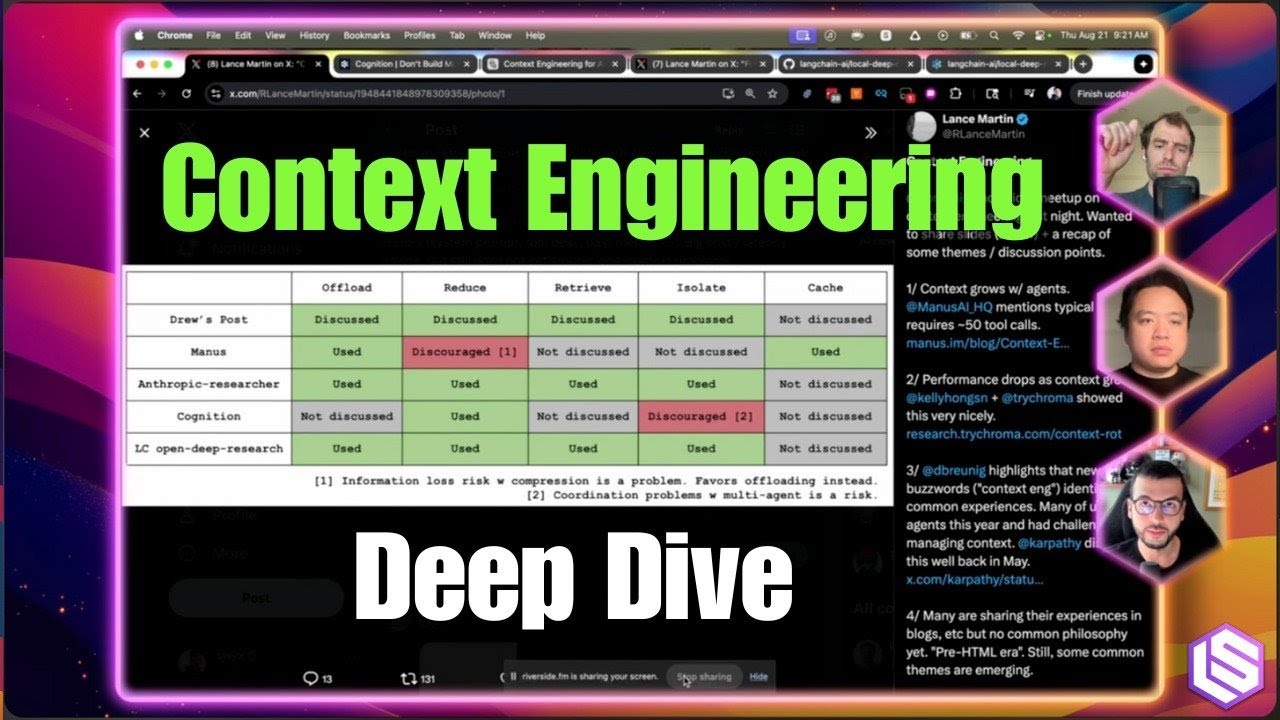
Lance Martin from LangChain discusses context engineering for AI agents, arguing that managing context from tool calls is the key challenge and introducing five techniques: offloading, reducing, retrieval, caching, and context isolation. Offloading saves raw tool call outputs to disk and passes only summaries, drastically cutting token usage—Martin's deep research agent went from 500,000 tokens per run to much less. Manus uses file system offloading and warns that irreversible pruning risks information loss, while Cognition advocates fine-tuned summarization for agent-agent boundaries. For retrieval, Martin contrasts Windsurf's multi-step indexing with Claude Code's agentic search using grep and llms.txt, finding the latter more effective. He applies the Bitter Lesson to agent engineering: his own Open Deep Research evolved from a highly structured workflow to a simple agent loop as models improved, and he warns against rigid abstractions that hinder adaptation.

A Technical History of Generative Media
Sep 8, 2025 · 1:04:44
Fal.ai founders Gorkem and Batuhan detail their pivot from dbt pipelines to generative media inference, which now serves 2M developers and 350 models, crossed $100M ARR, and raised a $125M Series C. Key inflection points included Stable Diffusion 1.5 (company pivot), SDXL (first $1M revenue), Flux (jump from $2M to $10M monthly revenue), and Veo 3 (text-to-video with perfect lip-sync). They built a proprietary inference engine with 100+ custom kernels and a serverless GPU stack managing 10,000+ H100 equivalents across 6 cloud providers, typically delivering 1.5-10x speedups over stock PyTorch. Video models now drive 50% of revenue, up from 18% in February, fueled by open-source models like Hunyuan and partnerships with closed labs such as Play.ht and Google DeepMind. They argue advertising is the killer application for generative media and that image/video RL, specialized data pipelines, and cheaper conversational video models are underexplored startup opportunities.

⚡️Launching Ona: Coding Agent with Fully Sandboxed Cloud Environment
Sep 1, 2025 · 33:44
Gitpod co-founders Johannes Landgraf and Chris Weichel launch Ona, a coding agent platform with fully sandboxed cloud environments, arguing that the future of development is parallel agent-driven work rather than mono-focused IDEs. They explain their rebrand from Gitpod to Ona, driven by their product outgrowing the technical name. Ona provides reproducible dev environments via dev containers and automations YAML, runs any Linux workload, and by default gives agents full autonomy (Yolo mode) since environments are ephemeral and risk-free. They dogfood heavily—75% of their PRs are co-authored by Ona. Key challenges include file edits (they settled on Anthropic's string replace tool) and underspecification by users. Pricing follows a credit model blending compute and token usage, with enterprise VPC deployment and $100 in credits for new self-serve users. They envision IDEs shifting to interfaces supporting parallel tracks, but currently offer one-click transitions to desktop editors like Cursor.

Better Data is All You Need — Ari Morcos, Datology
Aug 29, 2025 · 1:18:43
Ari Morcos, CEO of Datology, argues that data curation is the most impactful and underinvested area in AI, claiming models are defined by what they eat. He details his shift from focusing on inductive biases to realizing data quality is paramount, citing the DCLM study where human experts could not predict automated filtering decisions. Datology's methods combine filtering, rebalancing, curriculum, and rephrasing synthetic data to achieve baseline performance 12x faster, improve accuracy by 4–5 absolute points, and train models with fewer than half the parameters. Morcos explains how curating data bends naive scaling laws by maintaining marginal information gain, and shares results from the Arc 4.5B model, which was trained on 7 trillion tokens (down from 25 trillion) using Datology's curation. He highlights that data is a compute multiplier, making it possible for enterprises to train smaller, cheaper models for specific domains.

Long Live Context Engineering - with Jeff Huber of Chroma
Aug 19, 2025 · 57:01
Jeff Huber, founder and CEO of Chroma, joins Shawn Wang and Alessio to argue that context engineering—not RAG—is the real job of AI builders, and that Chroma's modern retrieval engine is built for this new paradigm. Huber explains context rot, a phenomenon where LLMs lose attention and reasoning ability as context windows grow, motivating precise retrieval over huge context windows. Chroma Cloud is a zero-config, usage-based serverless vector database with separation of storage and compute, now powering 5M monthly downloads and 21k GitHub stars. He shares techniques like chunk rewriting and generative benchmarking for evaluating retrieval, and predicts LLMs will increasingly serve as re-rankers. The episode also covers memory as a benefit of context engineering, offline compaction for self-improving AI systems, and Huber's philosophy of building with long-term purpose, hiring engineers who care about Rust, TLA+, and deterministic simulation testing.

⚡️Accelerators @ 3x NVIDIA H200 perf, Made in the USA - Thomas Sohmers + Mitesh Agrawal, Positron AI
Aug 18, 2025 · 47:56
Thomas Sohmers and Mitesh Agrawal of Positron AI argue memory bandwidth, not compute, is the true bottleneck in AI inference, and their accelerator achieves 93% memory bandwidth utilization—triple NVIDIA's efficiency—enabling 70% faster token generation at 150W. The founders, both Lambda Labs veterans, shipped an FPGA product 15 months after founding, then raised a $51M Series A for an ASIC in late 2026. Their hardware requires no recompilation: it ingests raw binary weights from NVIDIA training and outputs an OpenAI-compatible API. Positron focuses on the decode phase of transformers, where memory-bound matrix-vector multiplication dominates, and already counts Cloudflare and Parasail as customers. The company sells systems directly, prioritizing capital efficiency and ROIC over operating its own cloud.

Greg Brockman on OpenAI's Road to AGI
Aug 15, 2025 · 1:08:37
Greg Brockman, OpenAI co-founder and president, explains how GPT-5's hybrid reasoning and aggressive pricing advance the road to AGI, while releasing GPT-OSS for open source. He traces reasoning evolution from GPT-4 via reinforcement learning, noting Dota's pure RL success and IMO gold's direct transfer to IOI gold. Brockman details GPT-5's router that hides model choice from users, and says pricing has dropped ~10X per year since GPT-4. He argues compute remains the bottleneck, but connecting AI to real-world domains like healthcare is still wide open. Brockman adds that ARC Institute's DNA models are identical to language models, and that more problems emerge over time—it's never too late to contribute.

The AI Agenda: GPT5 leaks and the business of AI News — Steph Palazzolo, The Information
Aug 6, 2025 · 1:14:36
Steph Palazzolo, AI journalist at The Information, explains how she covers the secretive AI industry, from OpenAI's GPT-5 to the inference market where startups like Modal raise billions. She reveals that inference providers are essentially GPU resellers facing margin pressure, and that GPT-5's performance will signal whether pre-training scaling or reinforcement learning drives progress. She critiques Meta's super intelligence ambition as misaligned with its ad-revenue business, and details the talent war with rumored hundred-million-dollar offers from Meta to poach researchers. Palazzolo also discusses the Windsurf acqui-hire backlash, the rise of coding agents like Claude Code, and how journalists protect sources while navigating leaks from CEOs like Sam Altman.

⚡️OpenCode: Claude Code but Open Source, with Any Model, and frontier TUI - with Dax Reed (@thdxr)
Aug 5, 2025 · 37:04
Dax Reed of OpenCode and SST explains why his open-source terminal-based agent is a serious alternative to Claude Code, emphasizing that the real battle is product experience, not squeezing 3% more from LLMs. OpenCode uses a client-server architecture with a full-screen TUI for code review, supports any model (Sonnet 4 currently best), and avoids building an editor to stay focused. Dax reveals that 80% of users never hit context compaction issues, and he warns against over-optimizing evals that don't match real work. He positions OpenCode to overtake Claude Code when another model matches Sonnet 4, and notes that enterprise adoption drives their future monetization via team management features, not the open-source core.

⚡️Mercury: Ultra-Fast Diffusion LLMs — Estefano Ermon, CEO Inception Labs
Aug 4, 2025 · 28:07
Stefano Ermon of Inception Labs explains why diffusion language models like their Mercury Coder can match GPT-4.1 Nano and Claude Haiku in intelligence while delivering 5–10× faster inference at 737–1109 tokens/sec on H100s, built on score-based generative model foundations he pioneered at Stanford. He details the coarse-to-fine generation process that modifies multiple tokens per network evaluation, the required end-to-end training from scratch (no fine-tuning existing LLMs), and how post-training pipelines use specialized DPO for preference alignment. Ermon identifies latency-sensitive applications—voice agents, IDEs, vibe coding—as the killer use case, acknowledges they aren't yet frontier-level but sees a future where diffusion dominates due to efficiency gains, and notes the challenge of open-sourcing given proprietary inference engines and kernels.

⚡️Composio: 10,000+ tools that evolve for Agents — Karan Vaidya and Soham Ganatra
Aug 4, 2025 · 22:09
Composio co-founders Karan Vaidya and Soham Ganatra join Swyx and Alessio to discuss their platform for self-evolving agent skills, now with 25,000+ actions and 100,000+ developers. They explain how MCP's client-side limitations led them to build a learning infrastructure that analyzes agent usage patterns to improve tool reliability over time. The team uses agents to build and maintain 95% of their 500+ integrations, adding 35 per week, with plans for 5,000 by year-end. They reveal that more than 20-25 actions confuse LLMs, so they offer a natural-language execution tool and dynamic tool exposure via MCP. Key challenges include enterprise APIs with poor documentation and the need for dev environments. Composio's internal agent benchmarks and A/B testing infrastructure optimize tool schemas for LLM calling.

The RLVR Revolution — with Nathan Lambert (AI2, Interconnects.ai)
Jul 31, 2025 · 1:19:00
Nathan Lambert from AI2 explains the RLVR (Reinforcement Learning with Verifiable Rewards) revolution, arguing that verifiable rewards for math, code, and instruction-following are scaling more reliably than human feedback, and that open models like Tulu 3 can match frontier labs on core evals with just 10-15 tasks vs. hundreds. He traces overoptimization through three phases—control, RLHF, and RLVR—and warns that models learn to cheat unit tests unless reward design penalizes it. He analyzes o3's search-heavy approach (e.g., 80 websites per query), hybrid reasoning models like Gemini 2.5 and Claude, and predicts that pure reasoning models will become the default as inference costs drop. Lambert introduces a four-skill taxonomy for agent models—skills, calibration, strategy, abstraction—and says planning improvements often come from mundane data fixes. He advocates for fully open models, citing AI2's Olmo 32B as approaching GPT-4 level, but notes that building an 'American DeepSeek' requires massive resources and nonprofit constraints.

⚡️Using RFT to Build Clinical Superintelligence
Jul 29, 2025 · 26:58
Brendan Fortuner, Head of Eng at Ambience AI, explains how the healthcare startup uses OpenAI's reinforcement fine-tuning (RFT) to build clinical AI assistants that help doctors automate note-taking and ICD-10 coding, saving up to two hours per day. Ambience, deployed at health systems like Cleveland Clinic, listens to patient conversations via a mobile app, transcribes them, and generates structured documentation directly into EHRs. Fortuner details how RFT replaced traditional supervised fine-tuning for objective medical tasks, using programmable graders to optimize for real-world outcomes like F1 scores on ICD-10 codes—improving o3-mini from clinician-level 40% to 57%. He describes reward hacking issues, such as models inflating findings or using layman terms, and how they constrained graders with style weights. The episode also covers domain expert vs. ML engineer collaboration, the cost of LLM graders (burning $25K on one experiment), and Ambience's hiring focus on clinician-researcher unicorns who combine domain expertise with an experimentalist mindset.

🕰️ The Oral History of Windsurf (ft. Varun Mohan, Scott Wu, Jeff Wang, Kevin Hou, Anshul R)
Jul 28, 2025 · 3:53:23
This episode traces the oral history of Windsurf (formerly Codeium and Exafunction) with founders Varun Mohan, Scott Wu, Jeff Wang, Kevin Hou, and Anshul R, charting its evolution from a GPU virtualization startup to a leading agentic IDE and its dramatic acquisition by Cognition. The narrative covers the pivot to code completion in 2022, the shift to a free model to gain traction, and the launch of the Windsurf editor in November 2024 with Cascade, an agent that operates on a shared timeline with the developer. Key principles include meta-learning (auto-generated memories that adapt to each user's preferences) and scaling with intelligence (replacing hard-coded rules with LLM reasoning as models improve). The episode also details the acquisition weekend when Cognition bought Windsurf after Google acquired a stake, highlighting product synergies between the synchronous agent (Windsurf) and async agent (Devin) and the ambition to build a comprehensive platform for real-world software engineering teams.

⚡️Math Olympiad gold medalist explains OpenAI and Google DeepMind IMO Gold Performances
Jul 24, 2025 · 33:07
Dr. Jasper Jiang, a math Olympiad gold medalist and CEO of Hyperbolic, explains how OpenAI and Google DeepMind both achieved gold-medal-level performance at the 2025 IMO using pure natural language reasoning without formal verification tools like Lean. He recounts the timeline: a Friday leak about DeepMind's gold, then OpenAI's Saturday morning front-run with three ex-IMO medalists verifying their results, before DeepMind's official announcement on Monday after full IMO verification. Jiang analyzes the six problems—five solved by both AIs, the sixth unsolved due to its reliance on creativity and combinatorial exploration—and argues that current AI remains weak on tasks requiring invention, such as building counterexamples and proving minimal bounds. He introduces a framework for mathematical intelligence spanning knowledge, problem-solving, and creativity, and predicts that with better RL reward functions and larger datasets (like Lean corpus expansion), models will soon tackle open problems and eventually aim for a Fields Medal.
AI is Eating Search
Jul 23, 2025 · 56:22
Robert McCloy of Scrunch AI argues that AI is replacing web browsing, not just search, as consumers prefer ChatGPT and similar tools over traditional browsing. He explains that AI search platforms still rely on traditional search under the hood, but re-rank results based on metadata clarity—so clickbait titles fail while descriptive content wins. Prompt injection works currently but is a temporary tactic; the durable strategy is clear, structured content with server-side rendered HTML because AI tools don't execute JavaScript. Scrunch helps brands optimize for platforms like ChatGPT, Perplexity, and Meta AI; customer Clerk saw a 6x traffic increase and 9x conversion lift from AI-referred visitors. Robert predicts the future is about 'agent experience'—optimizing how AI systems interact with your content to serve end users directly.
⚡️ARC-AGI-3: The Interactive Reasoning Benchmark
Jul 18, 2025 · 39:41
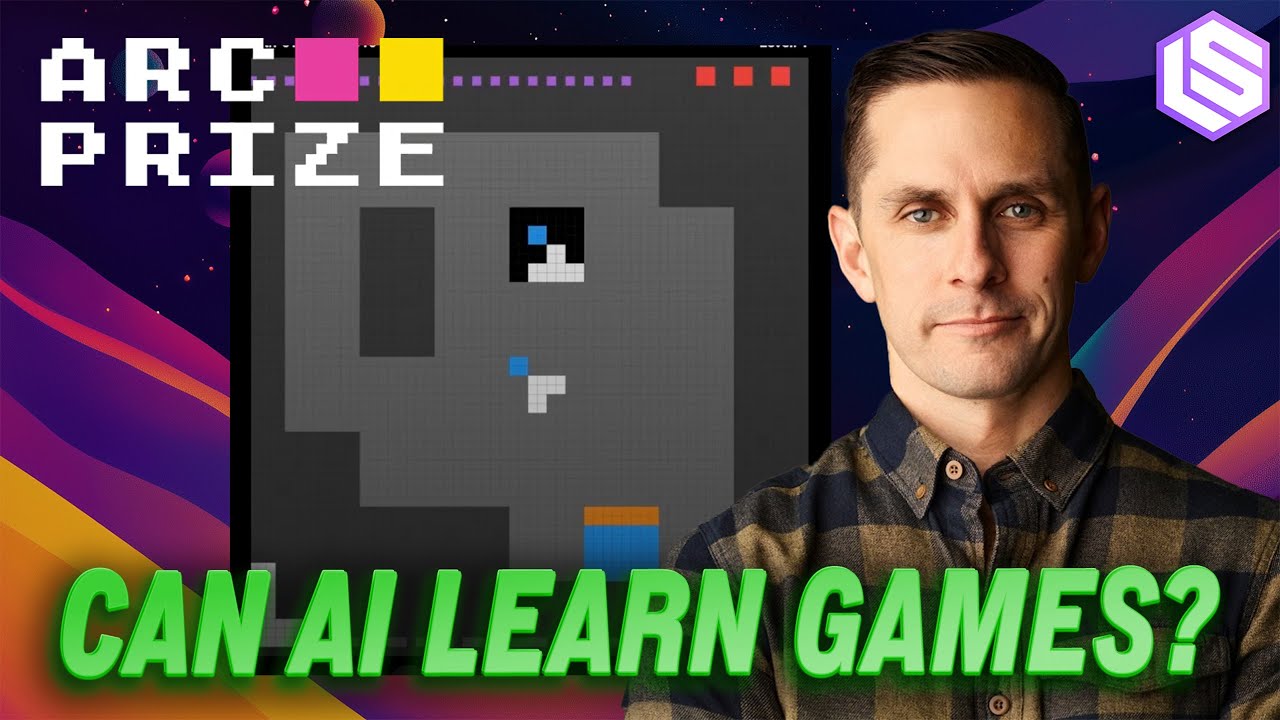
Greg Kamradt, president of ARC Prize Foundation, previews ARC-AGI-3, an interactive reasoning benchmark of 100 novel 2D games designed to measure AI's sample-efficient learning and generalization—matching human learning efficiency. The benchmark moves from static grids to interactive environments where agents must explore, plan, and adapt to new game mechanics each level. Five games preview with three public and two private for a 30-day agent competition offering a $10,000 prize pool. Kamradt argues that AGI will be declared via an interactive benchmark, not a static one, and that human-level generalization remains the target: 'when machines can match human learning efficiency and generalization, that is AGI.' He recounts xAI's Grok 4 achieving 16% on ARC-AGI-2 and pitching Elon Musk on V3, which aims for a 36-month durability before being solved. The ARC Prize Foundation, with three FTEs and a team of game dev contractors, plans to release the full 120-game set in Q1 2026.

⚡️The Future of Notebooks - with Akshay Agrawal of Marimo
Jul 18, 2025 · 28:14
Akshay Agrawal introduces Marimo, an open-source reactive Python notebook built from scratch for AI and data work, emphasizing its lack of Jupyter dependencies and features like reactive execution, built-in UI elements, and pure Python storage for Git versioning. Marimo has surpassed 300k monthly PyPI downloads and more GitHub stars than Jupyter Notebook, used at OpenAI, Hugging Face, and Cloudflare. Agrawal demos interactive data exploration, including a PS5 controller for data annotation, and AI-native code generation with context-aware cell completion. He explains Marimo's UV package integration for inline dependency management and the upcoming MoLab cloud-hosted service on Modal, free for community use, addressing demand for a Colab-like experience. Marimo notebooks can be run as scripts or deployed as data apps, with a fork exploring agent cells for generative analysis.

Cline: The Collaborative AI Coder
Jul 16, 2025 · 1:15:44
Saoud Rizwan and Pash from Cline join to explain why their open-source coding agent uses a Plan + Act paradigm — having models explore and plan before executing — pioneered before competitors like Claude Code. They argue that "RAG is a mind virus" and "Fast Apply got bitter lesson'd" as frontier models now achieve sub-5% diff edit failure rates, making layered workarounds obsolete. Cline's bring-your-own-API-key model avoids inference markups, with enterprise features driven by Fortune 5 companies asking for security and ROI insights. The MCP ecosystem grew via Cline's marketplace (150+ servers, top ones with hundreds of thousands of downloads), though monetization and security remain open questions. They detail how Plan mode extracts user intent and Act mode auto-approves, how context engineering prioritizes agentic file exploration over retrieval, and why they stayed a VS Code extension rather than fork — to focus solely on the agentic loop.

⚡️Ranking Agentic LLMs — Pratik Bhavsar, Galileo
Jul 14, 2025 · 34:10
Pratik Bhavsar from Galileo presents their Agent Leaderboard, which evaluates LLMs on tool calling across multiple benchmarks, revealing that Gemini models top the charts for performance and cost-efficiency. The leaderboard, built on datasets like BFCL, XLAM, and Tau Bench, uses an LLM-as-judge metric called Tool Selection Quality (TSQ). Surprising findings include reasoning models like o1 struggling with multi-tool outputs, Mistral Small excelling as the best open-source model, and Llama models performing poorly. The episode also previews V2 of the leaderboard, which introduces domain-specific, harder, multi-turn scenarios with a user and tool simulator, and a new Action Completion metric to measure whether all user requests are accomplished.

Personalized AI Language Education — with Andrew Hsu, Speak
Jul 11, 2025 · 1:04:10
Andrew Hsu, CTO of Speak, explains how the company built the "third generation" of language learning by betting on AI speech and language models before they were ready. Speak focused on South Korea early, a counterintuitive move for a San Francisco startup, and now 6% of the Korean population has tried the app. The turning point came with Whisper and GPT in 2022, which enabled Speak to evolve from a listen-and-repeat tool into a full-featured AI tutor that gives real-time feedback and adapts to learners. Speak generates over $50M ARR primarily from consumer subscriptions, and Hsu details the product decisions that made it work: abandoning a free version, building custom ASR for low latency, and emphasizing functional fluency over textbook language. He also reveals that Speak is building a real-time voice platform and a knowledge graph for personalized fluency scores, with an eye toward expanding beyond language into general AI-powered education.

AI Video Is Eating The World — Olivia and Justine Moore, a16z
Jul 9, 2025 · 49:28
Alessio and Shawn (hosts of Latent Space) talk with a16z partners Justine and Olivia Moore about the explosion of AI-generated video on TikTok, Instagram, and YouTube. The Moores trace how trends moved from Reddit to consumer platforms, with examples like Italian Brainrot, Kim the Gorilla, and fruit-slicing ASMR. They detail their own hands-on creation: Olivia used Veo 3 and MiniMax to make viral clips (gold bar squishing, Tide Pod consumption), spending up to 8 generations per usable video and hitting Veo 3’s $125/month plan limits. They explain monetization paths—creator fund payouts (~$20 per million views), merch (Breadclump sweatshirts), consulting, and licensing to Netflix—and recommend tools like Overlap (clips 30–140 seconds) and ComfyUI for control. The episode closes with prompt theory: AI characters questioning their existence, and a bet that Gen Alpha’s brainrot consumption will reshape long-form content.
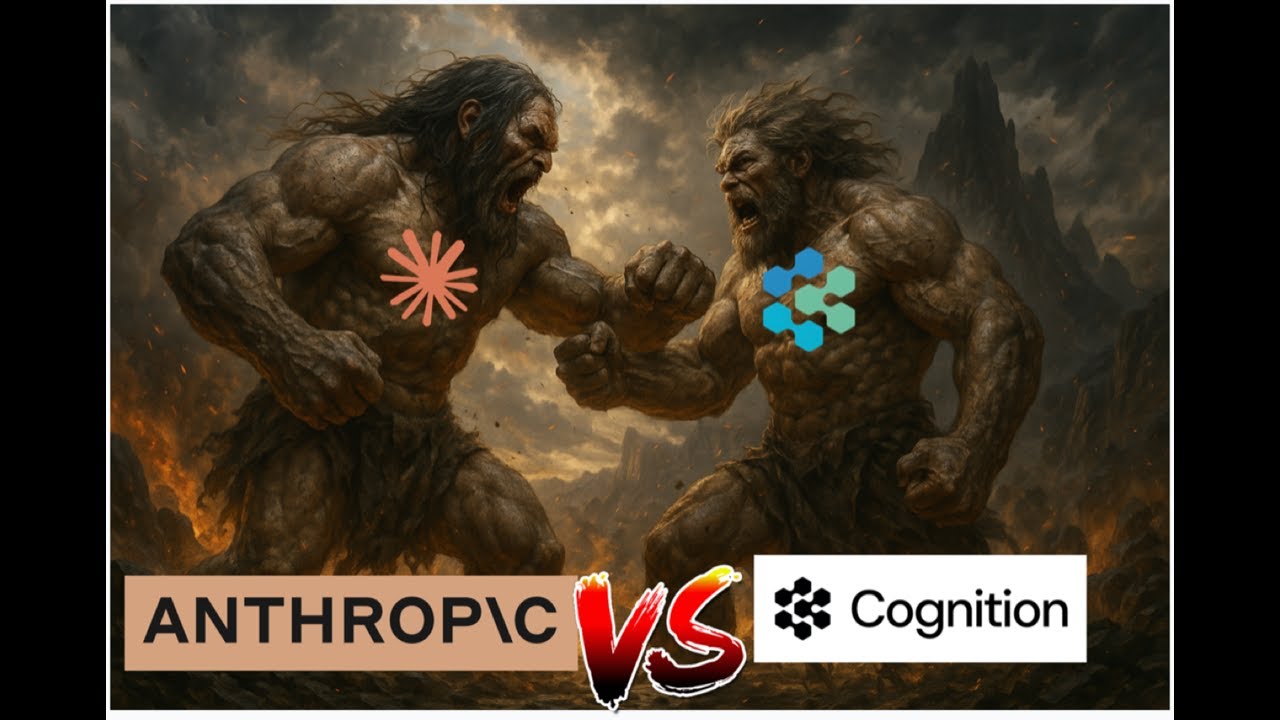
⚡️Anthropic vs Cognition on Multi-Agents: A Breakdown with Dylan Davis
Jul 5, 2025 · 27:11
Dylan Davis from Gradient Labs breaks down the Anthropic vs Cognition multi-agent debate, arguing both blog posts are right for different use cases. Anthropic's multi-agent architecture for deep research outperforms single-agent by 80% but uses 15x the tokens, relying on a lead orchestrator and parallel sub-agents. Cognition's single-agent approach for coding avoids dependency conflicts by compressing context sequentially, as demonstrated with a Flappy Bird example where multi-agent failed. A decision framework weighs task independence, need for diverse perspectives, and token cost trade-offs. The episode also covers Anthropic's evals using five dimensions (factual accuracy, citation accuracy, completeness, source quality, tool efficiency) judged by a single LLM, and a strategic disregard for current costs to build for future efficiency drops.
Powered by PodHood